



Published August 28, 2026
Last month, FRAC published a blog explaining the new public charge rule, which takes effect on Sept. 18, 2026.
Additional federal guidance released on Aug. 18 by U.S. Citizenship and Immigration Services (USCIS) provides more information about how the rule will be applied. This update summarizes what the guidance clarifies and what advocates need to know now.
What Does the Guidance Clarify?
The guidance is quite unclear and contains vague statements that could cause misunderstandings. What is emphasized is that:
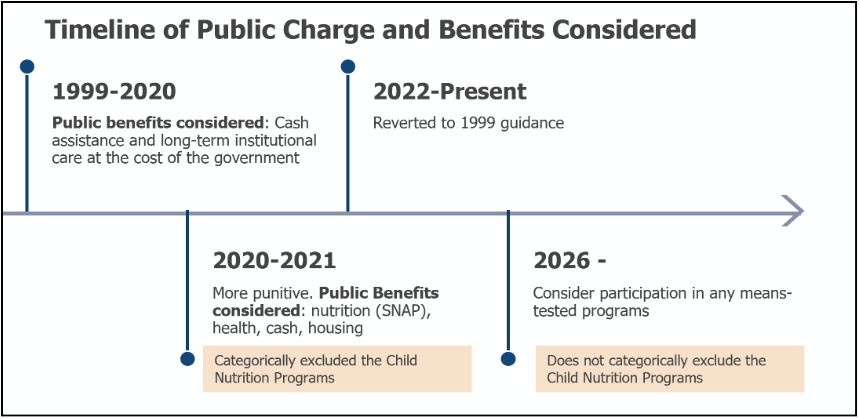
- Benefits received before Sept. 18, 2026, will be assessed under the 2022 rule. This means that only the longstanding rule that the use of cash assistance (such as Temporary Assistance for Needy Families, TANF, Supplemental Security Income, SSI, and state/local cash assistance programs) and long-term institutional care paid for by the government counted as factors in a public charge determination. The new rule and guidance state that means-tested benefits received on or after that date may be considered under the new rule.
- Reaffirms that public charge does not apply to all immigrants. Many immigrants are not subject to a Department of Homeland Security (DHS) public charge determination, including refugees; asylees; survivors of trafficking, domestic violence, or other serious crimes (T or U visa applicants/holders); Violence Against Women Act (VAWA) self-petitioners; special immigrant juveniles; certain people paroled into the U.S.; and other humanitarian immigrants. Legal permanent residents (green card holders) are not subject to a DHS public charge determination when they renew their green card or when they apply for U.S. citizenship. However, a legal permanent resident who leaves the country for more than 180 days may be subject to public charge determination when they seek to re-enter the country. U.S. citizens are not subject to public charge determinations.
- Allows immigration officers to consider the use of “means-tested” public benefits as a factor in whether someone is likely to become a public charge.
- Neither the new rule nor the guidance provides a statutory or regulatory definition of excluded or included means-tested programs.
- However, food assistance is called out as a category of means-tested programs, and the guidance’s hypothetical scenarios include school lunch and WIC as benefits that could be considered in public charge determinations.
- Allows officers to consider benefits used by certain family members, including U.S. citizen relatives, as part of an applicant’s public charge determination. The guidance states that USCIS will not treat benefits received by a U.S. citizen or lawful permanent resident child as benefits received by the parent. However, if a child or another household member receives income-based benefits tied to the applicant’s income or assets, USCIS may look more closely at whether the applicant meets the required financial threshold.
- Benefit use does not automatically determine whether someone is likely to be a public charge. When making a DHS public charge determination, an immigration official must consider the totality of the applicant’s life circumstances. Use of a public benefit program listed in the rule is one factor the official can consider, but a public charge determination cannot be made on this factor alone.
What Now?
- Urge your Members of Congress to pass the Protect American Values Act, which is legislation that blocks the implementation of the final public charge rule. This bill prohibits the use of any federal funds to implement, administer, enforce, or carry out the new Department of Homeland Security final rule on public charge.
- Stay informed. Protecting Immigrant Families has a public charge toolkit that includes information on who is affected by public charge and community talking points.
Resources
- Webinar recording: Public Charge and the Federal Nutrition Programs: What We Know So Far