



Published September 8, 2026
For more than 60 years, Head Start has supported young children during their most important phase of growth and development. For families with limited resources, Head Start is a trusted source of care, education, nutritious meals, and health services. Despite Head Start’s long history of bipartisan support, and demonstrated success, the U.S. Department of Health and Human Services (HHS) has a proposed new rule that would fundamentally change the program. Reducing Federal Burden for Head Start Programs, released on Aug. 7, 2026, would rescind and replace many current Head Start program requirements and standards, including several that promote child nutrition and healthy eating — even amid the current administration’s focus on nutrition (e.g. Make America Healthy Again).
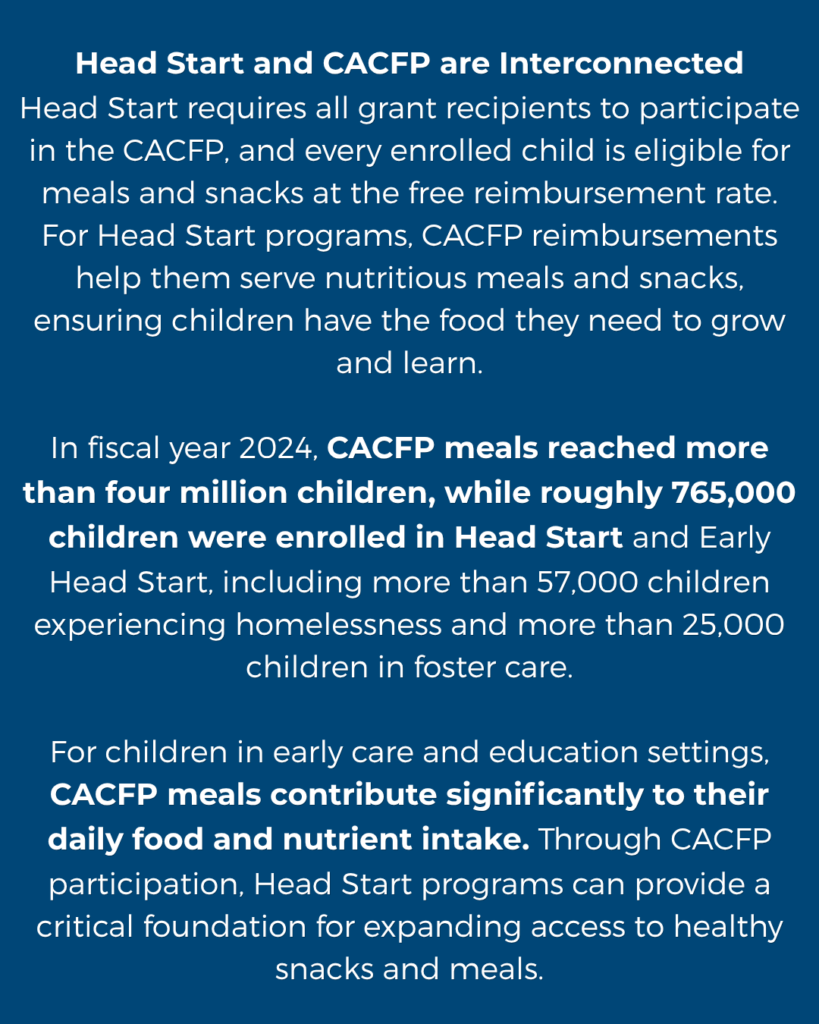
While the proposed rule does not directly reduce the number of children Head Start can serve, or cut the link to the Child and Adult Care Food Program (CACFP), it does remove existing safeguards, eliminate requirements that promote health, and significantly reduce a program’s capacity to deliver comprehensive services.
Historically, Head Start has promoted the nutrition of young children by:
- mandating that Head Start programs participate in CACFP, which is aligned with the HHS and U.S. Department of Agriculture’s Dietary Guidelines for Americans, which establishes meal patterns and nutrition requirements recommended for young children based on their age;
- requiring programs to provide culturally relevant, developmentally appropriate foods, with a focus on family-style meals — Head Start programs serve children from diverse backgrounds, providing foods that reflect their cultures, which can support their development, sense of identity, and connection to their family and community; and
- focusing on developmental indicators outlined in the Head Start Early Learning Outcomes Framework that are related to nutrition, such as children’s ability to identify a variety of healthy foods, demonstrate a basic understanding that eating a variety of foods helps the body grow and stay healthy, and moderate food consumption based on their own hunger and fullness cues.
Proven Benefits of Head Start
Children who participate in Head Start are more likely to have better health outcomes through childhood and into adulthood, including healthier eating patterns and body mass index (BMIs) compared with their peers. Beyond directly supporting children’s nutrition and health development, Head Start programs also help address hunger by supporting families’ enrollment in other programs like the Supplemental Nutrition Assistance Program (SNAP) and the Special Supplemental Nutrition Program for Women, Infants, and Children (WIC). These Head Start benefits and resource links are critical, as families and children who enroll in Head Start are more likely to face barriers accessing adequate food and nutrition, which can negatively impact a child’s diet quality, resulting in development and health problems.
The Proposed Nutrition Standards Would Be Less Specific and Supportive
The proposed rule would eliminate specific nutritional requirements and guidance to ensure children have access to healthy foods and develop eating habits that support their growth and development. Although the proposed rule includes the important assertion that Head Start programs must “serve nutrient-dense, whole foods consistent with CACFP,” the proposed nutrition section removes nearly all other additional nutrition guidance, including requirements for programs to:
- serve breakfast to children who arrive without having eaten at home;
- provide culturally relevant and developmentally appropriate foods;
- meet special dietary needs and accommodate children with disabilities;
- make safe drinking water available throughout the program day; and
- meet the nutritional/caloric needs of children depending on the hours a program is open.
While it is reassuring to see that CACFP remains a core part of Head Start’s program requirements, the proposed rule rescinds many other policies that support children’s overall nutrition and health.
Other Requirements the Proposed Rule Would Change
The proposed rule would eliminate or reduce many current federal Head Start requirements, that are important to the program’s integrity and success. The following table summarizes a few of these changes and why they matter for a child’s health:
| Proposed Rule |
Why It Matters for Children |
| Removes federal maximums for group–size and staff-to-child ratios, directing programs to follow state licensing requirements. | Instead of a national standard for Head Start ratios and group sizes, programs would align to state and local laws, which in most states are less rigorous than the current federal requirements. For teachers, this could mean caring for more children at one time — making it more difficult to address the unique needs and challenges of each child. |
| Lowers the cap on administrative costs from 15 percent to 5 percent. | Administrative costs help programs serve children and families, ensuring there is adequate funding and that programs run well. Less than 4 percent of Head Start programs currently operate at or below the proposed 5 percent cap. Lowering this cap will lead to programs reducing staff positions that are necessary to support Head Start programs’ effectiveness, safety, and support for families, teachers, and staff. |
| Scales back requirements for health, mental health, dental, and family engagement services. | Identifying health concerns early helps children and their families in the long run. When children have unaddressed developmental issues, it can get in the way of learning. For children in Head Start, their families may also lack adequate access to health coverage. The removal of specific requirements that outline how and when a program provides services will ultimately create more barriers — not fewer — for children who need these services the most. |
| Requires all instruction to be conducted in English, with exceptions for Tribal programs to preserve Tribal heritage. | Research shows that bilingual education does not slow English language acquisition. In fact, the opposite is true, Children benefit from learning multiple languages, and develop valuable cognitive skills, including stronger working memory and self-control. The Head Start Act — legislation passed by Congress, which outlines various functions of Head Start, requires programs to provide appropriate accommodations for children with limited English proficiency and that literacy instruction be linguistically appropriate. |
Now Is the Time to Strengthen Head Start, Not Weaken It
Every day, families struggle with the cost of food, child care, and health care. Head Start offers comprehensive support that ensures families can access all three, along with other critical services. Families need access to Head Start services that support their children’s healthy development and strengthen their well-being over the long term. Policymakers should focus on expanding and improving Head Start through Congressional reauthorization, rather than pursuing sweeping administrative changes that could undermine the program for the children and their families who depend on it. The administration should be investing in the people and systems that make Head Start so effective for young children and families.
Make Your Voice Heard
The proposed rule for Head Start is open for public comment through Oct. 6, 2026. FRAC will be developing and sharing comments in the upcoming weeks. Advocates, providers, and parents should tell the administration why strong Head Start standards matter and highlight the important link to CACFP, and the nutrition support these programs provide.