



Published September 10, 2026
The budget reconciliation law, H.R. 1, enacted in July 2025, made harmful changes to the Supplemental Nutrition Assistance Program (SNAP), including expanding who is subject to a three-month time limit. The U.S. Department of Agriculture (USDA) is expected to publish a proposed rule codifying the changes to work requirements for time-limited SNAP recipients.
Among H.R. 1’s consequential changes is the elimination of states’ longstanding ability to seek waivers of the SNAP time limit for participants living in areas that lack sufficient jobs. That authority had been part of federal law since Congress first imposed the time limit 30 years ago through the Personal Responsibility and Work Opportunity Reconciliation Act of 1996 (PRWORA). Even as Congress imposed a harsh new requirement on unemployed and underemployed adults, lawmakers recognized a basic reality: People cannot work in jobs that do not exist.
The underlying premise of PRWORA’s SNAP time limit was that those who can work should work. But the insufficient-jobs waiver recognized that an individual’s ability to meet a work requirement is inseparable from the availability of employment in the community where that person lives. H.R. 1 largely eliminates that safeguard. States can now seek geographic waivers only in areas with unemployment above 10 percent, with separate temporary rules for Alaska and Hawaii through 2028.
This change comes at a particularly difficult time. Families continue to face elevated food and household costs, while under H.R. 1 states must administer sweeping new SNAP eligibility rules with fewer federal resources and substantially greater financial responsibility. As Congress considers the 2026 Farm Bill, restoring states’ ability to temporarily respond to local labor-market conditions should be an urgent bipartisan priority.
The Insufficient-Jobs Waiver
PRWORA introduced one of SNAP’s harshest rules. It generally limited unemployed and underemployed adults ages 18–49 without dependent children to three months of SNAP benefits during a 36-month period unless they could document at least 80 hours per month of work or qualifying work-program participation. USDA labels people in this group as Able-Bodied Adults Without Dependents, or ABAWDs. H.R. 1 substantially expanded the population subject to the time limit.
After three countable months, a person’s SNAP benefits are generally terminated even if that person is actively searching for employment or cannot obtain enough hours of work. Therefore, in practice, the provision operates as a time limit on food assistance, not simply as a work requirement.
Recognizing that labor markets vary substantially across the country, Congress included a safety valve. The statute allowed states to request temporary waivers for areas where unemployment exceeded 10 percent, or where not enough jobs were available to employ the people subject to the requirement.
Importantly, this authority never automatically exempted an entire state, or any individual, from the time limit. It was a state option. States decided whether to apply, identified the geographic areas for which they sought relief, and submitted economic evidence to USDA supporting the request. USDA then determined whether the area satisfied the statutory criteria. Waivers were temporary and had to be renewed when labor-market conditions continued to justify them.
States did not use the option uniformly. In the third quarter of FY 2025 (April through June), six jurisdictions had statewide waivers, 25 had waivers covering only certain areas, and 22 had no waiver at all. In other words, the insufficient-jobs provision gave states a tool; it did not require them to use it. It allowed state officials to respond when objective labor-market conditions made participant compliance with the federal time limit particularly difficult.
The Waiver Reflected Bipartisan Recognition That Work Requires Available Jobs
The insufficient-jobs safeguard was not an accidental feature of the 1996 law. Republican lawmakers who helped establish the time limit emphasized that the policy assumed employment opportunities would be available.
During House debate, Reps. Robert Ney (R-OH) and John Kasich (R-OH) discussed the importance of state flexibility and employment availability. Kasich emphasized that the policy contemplated circumstances in which jobs were available, while Ney highlighted hardship protections and state waiver authority.
Congress ultimately codified that principle by expressly allowing states to obtain waivers for areas with unemployment above 10 percent or insufficient jobs.
For nearly three decades, USDA administered this authority through a framework requiring states to provide economic evidence demonstrating that the requested area satisfied the statutory standard. USDA guidance also recognized the realities facing workers in rural and economically distressed communities, where the number of people seeking employment can exceed available job opportunities, and historically permitted states some flexibility in defining waiver areas to reflect labor markets and administrative realities.
States Understand Their Job Markets Best
That principle remains relevant today: States are best positioned to identify where jobs are lacking and where waivers are necessary to prevent eligible individuals from losing food assistance solely because adequate employment opportunities do not exist. Former U.S. Department of Health and Human Services Assistant Secretary Peter Edelman observed that the primary challenge facing many affected individuals is not a lack of willingness to work, but a shortage of available jobs.
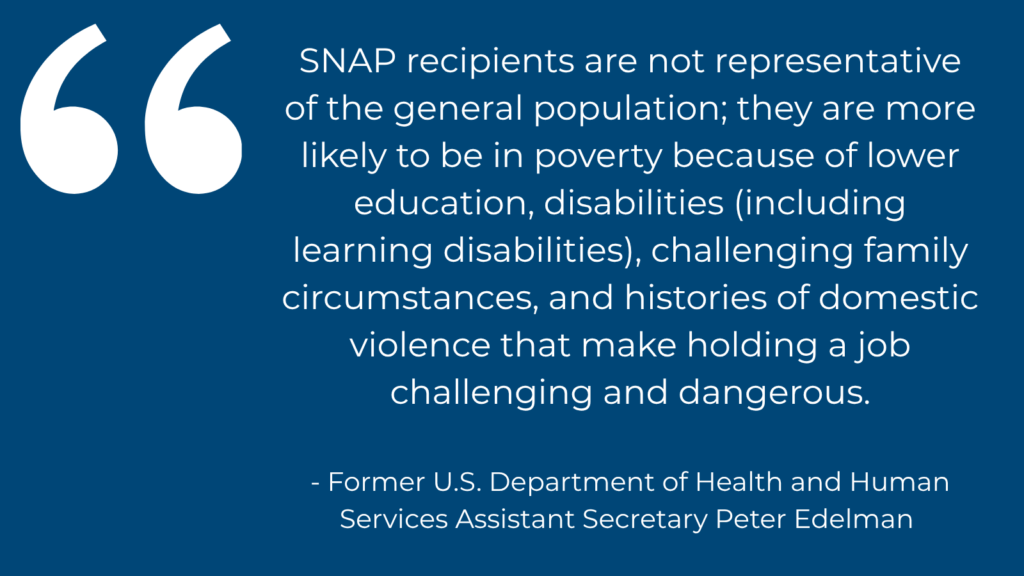
He noted that unemployed or underemployed SNAP recipients are not representative of the general population; they are more likely to be in poverty because of lower education, disabilities (including learning disabilities), challenging family circumstances, and histories of domestic violence that make holding a job challenging and dangerous.
A recent USDA study of SNAP Employment & Training (SNAP E&T) enrollment in rural Minnesota found that individuals referred to SNAP E&T faced many barriers to work, including lack of access to transportation, limited education or work history, and criminal backgrounds.
Expanding Time Limits Also Expands State Government Burden
The debate over SNAP time limits often focuses on what participants must do to retain benefits. Far less attention is paid to what states must do to administer the policy.
The administrative requirements are substantial.
States must identify which participants are potentially subject to the time limit; screen them for exemptions; obtain and evaluate verification; explain work requirements; track qualifying work and activities; monitor countable months; process changes in circumstances; issue notices; determine when benefits must terminate; and address disputes, appeals, and corrections.
Expanding the population subject to the time limit expands each of these functions.
State implementation estimates following H.R. 1 demonstrate the magnitude of that burden.
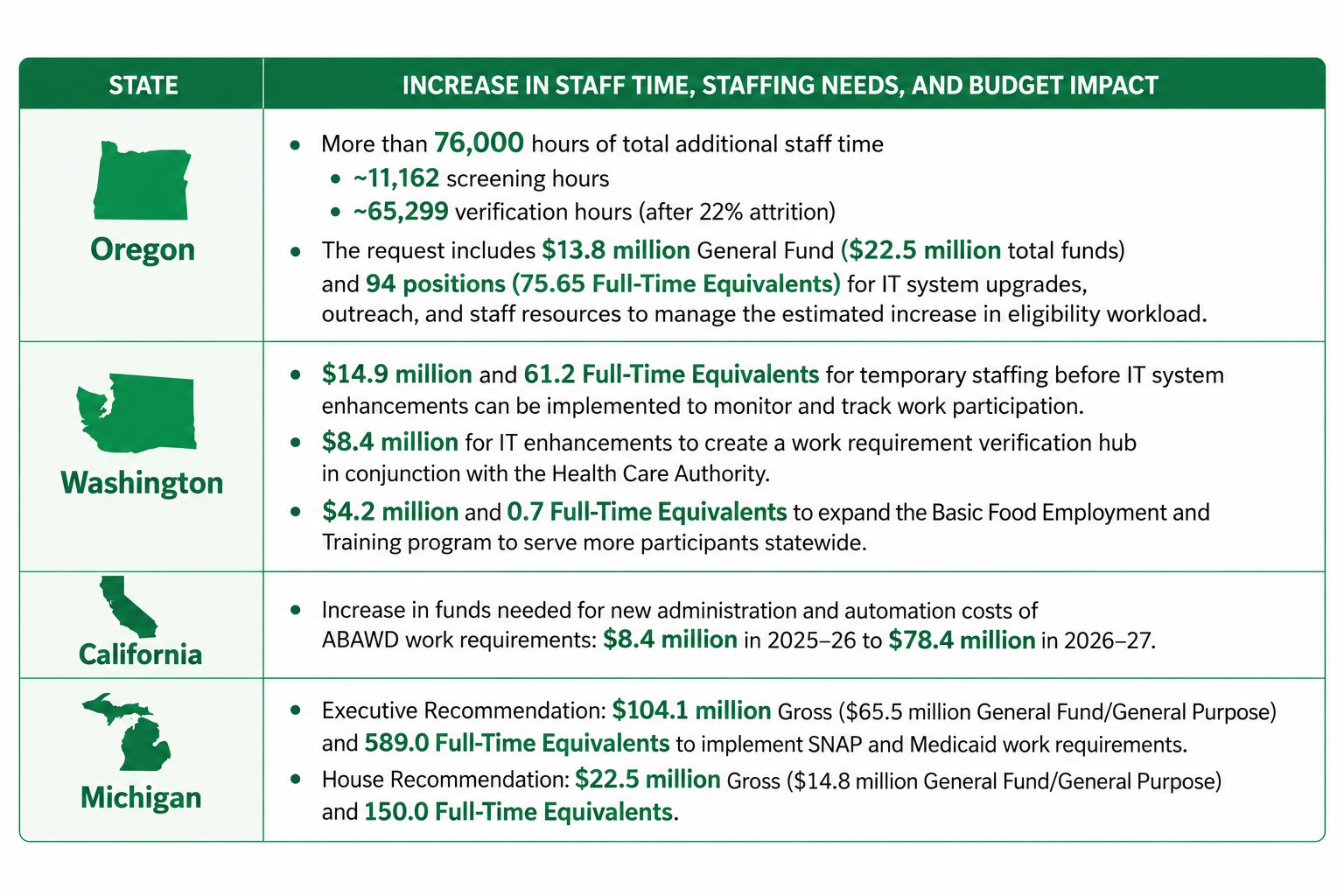
Oregon, for example, estimates that expansion of the population subject to SNAP time limits will generate more than 76,000 additional staff hours. That includes approximately 11,162 additional screening hours and 65,299 verification hours, even after accounting for projected attrition. Oregon’s broader implementation request includes $13.8 million in general fund support, $22.5 million in total funds, and 94 positions (75.65 full-time equivalents) for related staffing, outreach, and information-technology needs associated with increased eligibility workload.
Washington identified $14.9 million and 61.2 full-time equivalents for temporary staffing needed before automated system enhancements can monitor and track work participation for the larger population subject to the requirements. The state separately identified $8.4 million for information-technology enhancements to establish a work-requirement verification hub and $4.2 million and 0.7 full-time equivalents to expand Basic Food Employment and Training services.
California estimates a dramatic increase in administrative and automation resources associated with implementation of the expanded work requirements, from approximately $8.4 million in 2025–26 to $78.4 million in 2026–27.
Michigan’s executive budget recommendation similarly includes $104.1 million gross and 589 full-time equivalents for implementation of combined SNAP and Medicaid work requirements, including increased casework and beneficiary outreach and education. Because Michigan’s estimate covers both programs, it should not be attributed solely to SNAP, but it nevertheless illustrates the scale of administrative infrastructure required to implement expanded federal work requirements.
H.R. 1 SNAP Time-Limit Expansion Strains Resources
State budget and workload estimates demonstrate that expanding SNAP time limits requires substantial new investments in screening, verification, staffing, technology, SNAP E&T and participant outreach. Figures reflect state estimates and budget requests and are not directly comparable across states.
The irony is hard to ignore: H.R. 1 increases the administrative work states must perform while also requiring them to shoulder a greater share of the cost.
Beginning in fiscal year 2027, the federal reimbursement rate for most SNAP administrative expenses falls from 50 percent to 25 percent, leaving states responsible for 75 percent of those costs. States must, therefore, finance a larger share of the eligibility staff, technology, verification, outreach, and other administrative infrastructure needed to implement federal requirements that have become substantially more complex.
Restoring meaningful waiver flexibility would not eliminate states’ administrative responsibilities, but it could let them concentrate limited resources where they are most useful, rather than repeatedly administering a time limit in communities where insufficient employment makes compliance particularly difficult.
Congress is increasing costs for states while simultaneously diminishing their rights and options for implementing the program. This approach is unjustified. Congress cannot demand more while providing less and simultaneously stripping away the tools needed to manage the program effectively.
Benefits of Time-Limit Waivers
- Reduce Administrative Burdens and Error Risk
The waiver authority also helped address the significant administrative challenges associated with the ABAWD policy. Since the enactment of time limits in 1996, states have consistently reported that the policy is difficult and costly to administer. Unlike most SNAP eligibility requirements, ABAWD provisions require states to track exemptions, work activities, waiver eligibility at the individual level, and the months people are in and out of compliance. Federal reviews have found that states implement time-limit waivers and exemptions differently and that the complexity introduces errors, with eligible individuals losing benefits or ineligible individuals receiving assistance. Several states have reported that waiving time limits reduces administrative burden and lowers the risk of errors. As states assume substantially greater responsibility for SNAP financing under H.R. 1, preserving flexibility to administer the program efficiently becomes increasingly important. - More Meaningful Employment Programs
The insufficient-jobs waiver also created the possibility of a more meaningful, work-focused approach. USDA does not require states to offer SNAP E&T spots to all ABAWDs, and ABAWD rules restrict the types of activities that satisfy program requirements. For instance, job search programs do not count towards the minimum hour requirement, so states must provide more resource-intensive training, education, or workfare opportunities. Because many states lack sufficient resources, they limit the availability of these programs. When time limits are waived, SNAP E&T programs can be designed to support SNAP participants’ specific career and education goals rather than merely serving as a compliance mechanism for some ABAWDs to avoid losing their benefits.
The Elimination of the Insufficient-Jobs Waiver Was a Serious Mistake
H.R. 1 eliminated states’ ability to seek waivers due to insufficient jobs, leaving only the unemployment-rate waiver for areas with unemployment exceeding 10 percent. This change removes a longstanding tool that allowed states to account for local labor market conditions and replaces it with a rigid threshold that fails to capture the realities of many communities.
The elimination of the insufficient-jobs waiver is particularly concerning given the broader changes enacted through H.R. 1. The law expands SNAP time limits to additional populations, including adults ages 55 to 64, parents and caregivers of children age 14 and older, veterans, individuals experiencing homelessness, and youth aging out of foster care. Since July 2025, more than 5.5 million people have already lost SNAP benefits, and additional losses are expected as expanded time-limit provisions continue to take effect across the country.
At the same time, H.R. 1 fundamentally altered the federal-state partnership that has governed SNAP for decades. Beginning in fiscal year 2027, states must finance 75 percent of SNAP administrative costs, and beginning in fiscal year 2028, states must contribute to SNAP benefit costs based on payment error rates for the first time in the program’s history. As states assume greater financial responsibility for program administration and benefits, they should retain meaningful authority to determine whether local labor market conditions provide sufficient employment opportunities for affected populations.
Congress recognized the importance of local flexibility by preserving additional waiver pathways for Alaska and Hawaii, reflecting their unique labor market conditions — H.R. 1 allows Alaska and Hawaii to qualify for the statewide ABAWD exemption with an unemployment rate that is at or above 1.5 times the national unemployment rate, effectively lowering the unemployment rate that these states must meet to receive a waiver.
But Alaska and Hawaii are not the only states containing communities with distinctive economic circumstances. Across the country, rural areas, Tribal communities, agricultural regions, former manufacturing centers, and other economically distressed communities can experience persistent shortages of accessible employment even when unemployment does not exceed 10 percent.
Yet every state contains communities with distinct economic circumstances, including rural areas, Tribal communities, agricultural regions, former manufacturing centers, and other localities facing persistent job shortages. States are best positioned to assess these conditions and determine where waivers are warranted.
Congress Should Reinstate the Time-Limit Waiver Option for States
Through the Farm Bill, or any legislative vehicle, Congress can and should ensure that all states, not just a select few, have a meaningful opportunity to demonstrate that local labor market conditions do not provide sufficient jobs and to obtain waivers that protect eligible individuals from losing food assistance when adequate employment opportunities are unavailable. Restoring this authority would honor congressional intent, recognize the expanded role states now play in financing and administering SNAP, lower payment errors, and better align program administration with economic realities in communities across the nation.