



Late Friday evening, Senate Agriculture Committee Chair John Boozman (R-AR) released updated legislative text for the Farm Bill, and said he plans to hold the committee’s markup on Thursday, Aug. 6, at 9:30 a.m. ET.
The updated proposal, in terms of the Nutrition Title, remains largely unchanged, except that it includes funding for the implementation of chip-enabled Electronic Benefit Transfer (EBT) cards and adds a revision to the cost-share provision. See previous analysis.
While it provides a one-year delay for most states before Supplemental Nutrition Assistance Program (SNAP) benefit cost sharing begins, it does not delay the administrative cost shift that takes effect this October, does not change the reference dates for payment error rates used to determine the new state financial responsibility, and ultimately increases the maximum state share of SNAP benefit costs beginning in fiscal year (FY) 2031. It also leaves the authorization to use contractors to perform key SNAP eligibility support functions, advancing the privatization of SNAP administration despite prior state experiences showing that outsourced eligibility operations can increase processing delays, payment errors, and wrongful denials.
Most importantly, it does little to address the reality that almost 5 million people have already lost access to SNAP since the budget reconciliation law (H.R. 1) was passed. Without meaningful changes, that number will continue to grow.
In May, all Democrats on the Senate Agriculture Committee made it clear that they will not negotiate a Farm Bill that fails to address the harms H.R. 1 has caused to food assistance. FRAC welcomes that commitment and hopes Senate Democrats continue to hold the line, ensuring that any final Farm Bill meaningfully restores and strengthens SNAP rather than locking in harmful cuts.
What the Proposal Changes
Provision | H.R. 1 (Current Law) | Updated Senate Proposal |
Administrative cost shift | Begins FY 2027 (states pay 75% of SNAP administrative costs) | No change |
Benefit cost sharing begins | FY 2028 | Delayed to FY 2029 |
Payment error rate reference years | FY 2026 error rates determine state share | No change |
Delayed implementation for certain high-error-rate states to FY 2030 | Delayed implementation applies | Retained |
State share of SNAP benefit costs for PER at or above 10% | 15% | 20% beginning FY 2031 |
The proposal gives most states only a one-year delay before benefit cost sharing begins. States qualifying under the delayed implementation provision because of exceptionally high historical payment error rates continue to receive an additional year before implementation.
If Congress believes states need additional time to prepare for these unprecedented fiscal obligations, that relief should be applied consistently across all states. The Farm Bill presents an opportunity to provide that parity.
One-Year Delay Does Not Change the Underlying Reference Formula
The proposal delays the start of SNAP benefit cost sharing from FY 2028 to FY 2029, but it does not change the payment error rates used to calculate what each state will ultimately pay. (Read more about why PERs are a flawed metric).
This distinction is critical.
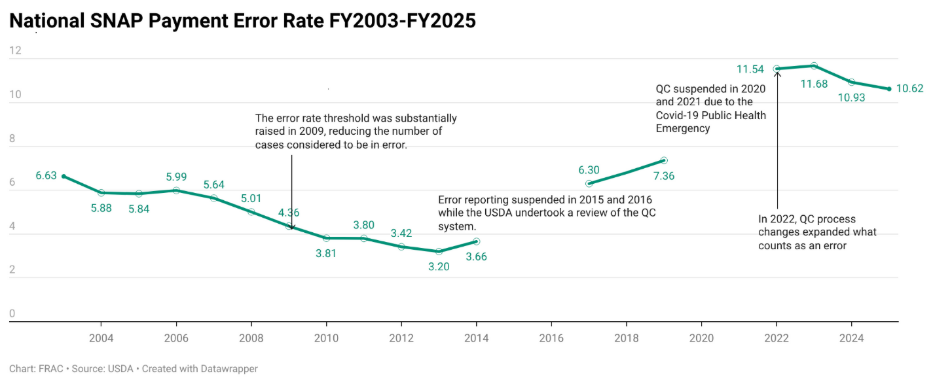
When H.R. 1 became law, the U.S. Department of Agriculture (USDA) acknowledged that the payment error rates used for the new cost-sharing system were essentially already established, meaning they would not reflect operational improvements states have made since enactment.
As a result, the proposal simply gives states another year to budget for this new cost. It does not give them another year for improvements in payment accuracy to be reflected in the payment error rates that determine their future financial obligations.
In other words, states are given more time to gather the necessary funds, not to lower their PER. This distinction is important because most states have already seen a decline in their PER, but this process takes time; it does not happen overnight.
Administrative Cost Shift Still Begins This October
The proposal does not delay the SNAP administrative cost shift enacted under H.R. 1.
Beginning in FY 2027 (October 2026), every state will be required to pay 75 percent of SNAP administrative costs, while federal reimbursement will fall from 50 percent to 25 percent. This change alone will shift approximately $17 billion over five years from the federal government to states.
The timing could not be worse.
Because of H.R. 1, state SNAP agencies are implementing the largest operational transition in decades. They must redesign eligibility systems, update technology, retrain staff, revise policy manuals, rewrite notices, implement expanded work requirements and time limits, strengthen quality control, improve customer service, expand fraud-prevention efforts, and deploy chip-enabled EBT cards.
Each of these responsibilities requires additional administrative resources, not fewer. Reducing federal administrative funding while asking states to improve payment accuracy makes that goal substantially more difficult. Rather than creating incentives for better program administration, the administrative cost shift leaves states trying to implement sweeping policy changes with significantly fewer federal resources.
The pressure also extends beyond state agencies. As Congress shifts more financial responsibility to states, it must also consider the support of the federal agency responsible for supporting them. USDA is asking states to implement some of the most complex SNAP changes in decades while USDA is simultaneously experiencing workforce disruption following its push to relocate much of the department’s workforce. State agencies have increasingly reported delays in receiving technical assistance, policy guidance, and timely responses to implementation questions. Successful implementation depends on a strong federal-state partnership. States cannot be expected to shoulder unprecedented new responsibilities without the federal support necessary to carry them out effectively.
The Proposal Continues Unequal Treatment of States
The updated proposal also continues to treat states differently.
Under the proposal:
- Most states receive only a one-year delay, with benefit cost sharing beginning in FY 2029.
- States that qualify under the delayed implementation provision because of exceptionally high payment error rates continue to receive an additional year, delaying implementation until FY 2030.
If Congress believes states need additional time to prepare for these unprecedented fiscal obligations, that relief should be applied fairly across all states. Instead, the proposal preserves unequal implementation timelines while leaving the underlying payment error rate calculations unchanged.
The Farm Bill provides Congress with an opportunity to correct this imbalance and establish a more equitable implementation schedule.
States Are Warning About the Consequences
State agencies are not questioning the importance of improving payment accuracy or strengthening program integrity. They remain deeply committed to both goals. However, they consistently report that achieving those goals requires stable operations, adequate staffing, modern technology, sufficient administrative funding, and timely federal guidance.
A recent survey of state SNAP agencies underscores the magnitude of the challenges they are preparing for as the new benefit cost-sharing requirements approach.
States identified several potential consequences of the new financing structure:
- 42 percent (16 states) identified freezing or reducing hiring as a likely response.
- 29 percent (11 states) identified narrowing eligibility policies as a potential consequence.
- 11 percent (4 states) indicated they may consider withdrawing from or pausing participation in SNAP if the financial burden becomes unsustainable.
These findings illustrate that states are actively preparing for the fiscal consequences of H.R. 1 while continuing to invest significant effort in improving payment accuracy. They are evaluating how new financial obligations will affect staffing levels, technology modernization, participant access, quality control activities, and overall program operations.
Their experience demonstrates an important reality: Payment accuracy improves when agencies have the resources to hire and retain experienced staff, modernize eligibility systems, provide ongoing training, strengthen quality assurance, and receive timely technical assistance from USDA. Reducing administrative funding while increasing operational complexity makes those improvements more, not less, difficult to achieve.
Higher Costs Still Await Many States
The proposal also increases the long-term financial obligation for states with payment error rates of 10 percent or higher.
Beginning in FY 2031, those states would pay 20 percent of SNAP benefit costs, compared with 15 percent under current law.
Historically, payment error rates rarely decline dramatically over a short period, particularly while agencies are managing fewer resources and implementing major policy changes. Even states receiving delayed implementation may still remain above the 10 percent threshold when the higher 20 percent cost share takes effect. See table with estimated administrative and benefit cost share expenses.
The Farm Bill Is Congress’s Opportunity to Repair H.R. 1
The Farm Bill is a major legislative opportunity to address the unprecedented SNAP changes enacted through H.R. 1.
The proposal leaves intact the administrative cost shift, preserves the historical payment error rate lookback, increases long-term costs for some states, does not provide parity for states, and does not provide states with the resources necessary to successfully implement the sweeping changes already underway.
Most importantly, it offers no meaningful relief for the almost 5 million people who have already lost SNAP and does little to prevent additional families from losing assistance as implementation continues.
Take Action: The Next Few Days Are Critical
The Senate Agriculture Committee will mark up the Farm Bill on Thursday, August 6. The period between Monday and Thursday represents the most important opportunity for advocates to influence the legislation before committee members vote.
Advocates should urge Senators in the Agriculture Committee to:
- Delay both the SNAP administrative cost shift and the SNAP benefit cost-sharing provisions to two years, without extending or increasing states’ future financial obligations.
- Update the payment error rate reference years so states receive credit for improvements made after H.R. 1 was enacted.
- Provide equal implementation relief for all states rather than maintaining different timelines for higher payment error rate states like Alaska.
- Restore adequate federal administrative funding, so states have the resources necessary to improve payment accuracy, modernize systems, train staff, and successfully implement SNAP.
- Reverse the harmful SNAP cuts enacted in H.R. 1 and restore SNAP’s longstanding federal commitment to fighting hunger.
If the legislation advances out of the Senate Agriculture Committee, advocacy cannot stop there.
As Members of Congress return home for the August recess, advocates should continue meeting with Senators, attending town halls, engaging local media, submitting letters to the editor, and sharing how these policies are affecting families, food retailers, food banks, farmers, local economies, and state budgets.
The Farm Bill process will continue beyond committee markup, and sustained advocacy will be essential at every stage. Congress still has the opportunity to repair the damage caused by H.R. 1. The question is whether it will choose to do so.