


Published June 29, 2026
The Special Supplemental Nutrition Program for Women, Infants, and Children (WIC) is a federal nutrition program that provides nutritionally at-risk pregnant, postpartum, and breastfeeding individuals, infants, and children up to 5 years old with essential nutrition resources and support, including healthy foods, nutrition education, breastfeeding support, and health care referrals.
In FRAC’s national and State-by-State WIC Fact Sheets, anti-hunger advocates, policymakers, and other stakeholders can find key information on the reach and importance of WIC and ways to ensure more eligible people can access the program — all in a single page.
Benefits of WIC
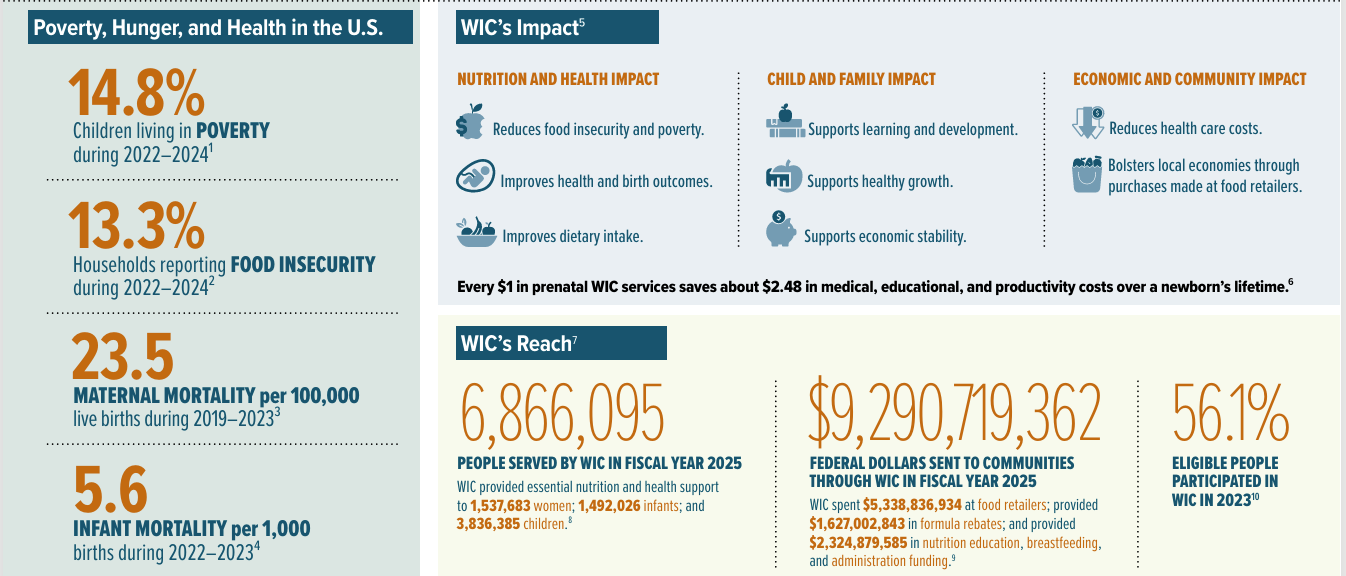
The fact sheets lift up the detrimental impacts of poverty, food insecurity, and health data, as well as research on how WIC is a vital economic, nutrition, and health support for children and families. For example, every $1 in prenatal WIC services saves about $2.48 in medical, educational, and productivity costs over a newborn’s lifetime.
WIC’s Reach
The fact sheets also highlight data on WIC participation and federal dollars drawn into the state, helping stakeholders see the impact of WIC in their state and the gaps in program access. Data looking at the comparison of eligibility to participation — known as the coverage rate — can be particularly helpful for understanding the need to connect more people to WIC.
Despite the substantial body of research on the benefits of WIC, far too many eligible people are missing out on the program. Nationally, only 56.1 percent of eligible women, infants, and children received WIC in 2023 (latest available data) — meaning nearly 5.2 million people were missing out on WIC’s support. Coverage rates are especially low for children eligible for WIC, who often fall off the program once they reach age 1, and for pregnant women.
Coverage rates vary widely by state. The top-performing states in 2023 were Vermont (79.6 percent), California (72.4 percent), and Massachusetts (68.7 percent), while Missouri (43 percent), Montana (42.9 percent), and Louisiana (41.3 percent) had the lowest rates.
Check out your state’s WIC fact sheet to see how your state compares to others and how you can support WIC.