



Published June 10, 2026
Supplemental Nutrition Assistance Program (SNAP) payment error rates (PER) are in the spotlight. The H.R. 1 megabill changed the way that SNAP benefits will be paid for: Starting in 2027, states will be responsible for a portion of SNAP benefit costs (5 percent to 15 percent) depending on their error rates. This is a totally new approach — while states have always been responsible for a portion of administrative costs, the actual SNAP benefits delivered to people to buy food have always come from the federal government.
This change is putting enormous pressure on states to get their error rates down. States are changing the way they administer SNAP, shortening certification periods, requiring more onerous verifications, removing self-attestation, ramping up quality assurance reviews, and more.
With all this attention on payment errors, it’s important to understand what they measure, and what they do not. When a SNAP benefit is issued for the wrong amount, either too much or too little, it’s counted as a payment error. This includes an applicant household being accepted onto the caseload when they shouldn’t have, usually because of a mistake calculating their deductions and net income. What the PER does not measure is households denied SNAP when they should have been accepted or when a household’s benefits are erroneously suspended or cancelled. Those administrative mistakes are counted separately as case and procedural error rates, or CAPER. CAPER is roughly a measure of access to SNAP; low rates mean that people who are eligible for SNAP are getting the benefits they need to support nutrition and well-being. CAPERs don’t measure everything that prevents people from accessing SNAP, however. For instance, If an applicant cannot get through to a caseworker to complete their eligibility interview (a common experience for many applicants), that case would be classified as properly denied, with the reason marked as “failure to complete interview,” and would not be included in the CAPER calculation.
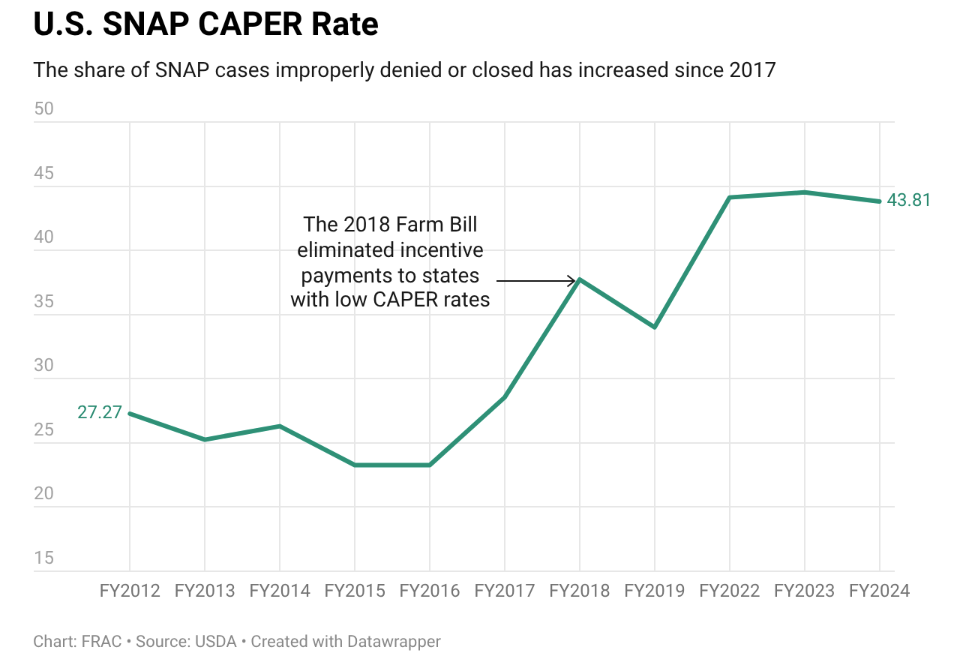
Historically, measuring both the CAPER and PER kept state SNAP agencies focused on the balance between accuracy and access. To give an extreme example: If a state denied all SNAP applications, their PER would be 0, with absolutely no SNAP payments being given out for the wrong amount. However, their CAPER rate would be high — 100 percent of cases that were eligible for SNAP would have been denied. The U.S. Department of Agriculture (USDA) has long had a system of rewards and penalties to encourage balance: requiring corrective action plans for states with payment error rates above 6 percent or CAPER rates above the national average; imposing sanctions for states that do not make improvements to their payment error rates; and issuing performance bonus payments to states with high performance and effective administration, including low CAPER rates. However, the performance bonuses were eliminated in the 2018 Farm Bill, leaving a system that punishes payment errors but does not reward states for ensuring access. The benefit cost-shift now adds another layer of negative outcomes for high payment error rates, with no counterbalance to prioritize access. This is a textbook case of bad incentives.
This brings us to where we are now: States’ intense focus on payment error rates is matched by a huge drop in SNAP participation. Arizona lost 50 percent of its SNAP caseload between January 2025 and February 2026. Georgia saw its caseload drop by more than half a million people. This is not because of decreased need, it’s because eligible people are being denied SNAP benefits or are pushed away from the program. The most recent national CAPER rate, from fiscal year (FY) 2024, is 43.81. It’s above 50 in 14 states, meaning more than half of eligible SNAP applicants and participants there have been wrongfully denied or had their benefits terminated. In Georgia, the CAPER is 82.3. The FY 2024 national CAPER is more than four times that year’s payment error rate of 10.93. These numbers are outrageously high, and they reflect the period before H.R. 1. Newer numbers, for FY 2025, should be available at the end of June.
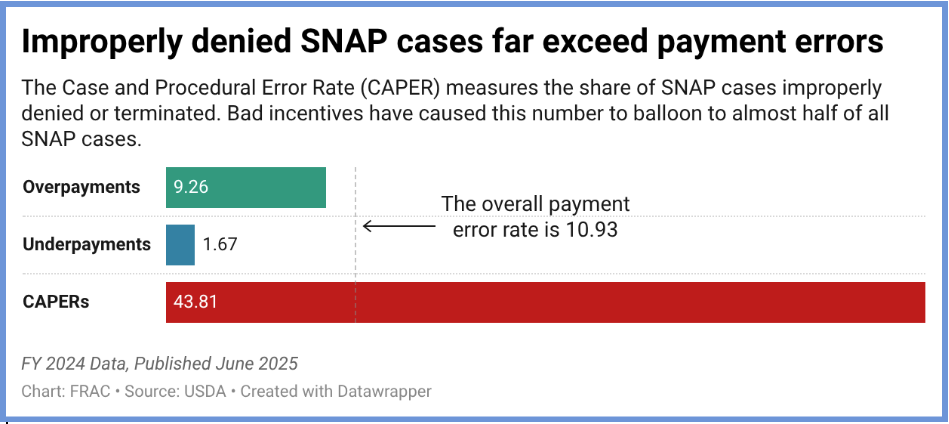
SNAP is an incredibly effective program, improving food security, health, and economic stability for those who participate. But these benefits only accrue to people who are able to access the program, and the CAPER numbers tell us that’s not nearly enough. As the rush to reduce error rates and avoid state financial responsibility for SNAP benefits intensifies, we all need to keep an eye on the CAPER to hold states accountable for making sure SNAP benefits are actually serving those in need.