


Published June 12, 2026
As of December 2025, the U.S. Department of Agriculture (USDA) has a notice of proposed rulemaking pending that would eliminate states’ ability to use broad-based categorical eligibility (BBCE), a policy that streamlines the administration of the Supplemental Nutrition Assistance Program (SNAP). Currently, 43 states and the District of Columbia use BBCE to help ensure that food-insecure residents have access to the nutrition they need to thrive.
BBCE Is Essential to Making SNAP and Other Nutrition Programs Work
BBCE is a longstanding, congressionally authorized SNAP policy that allows states to extend eligibility for SNAP to people who receive a Temporary Assistance for Needy Families (TANF) noncash or a state Maintenance of Effort funded benefit. BBCE lets SNAP align eligibility thresholds for income and assets with TANF’s eligibility thresholds. It streamlines administration, supports work, encourages families to build modest savings, and aligns SNAP with the work-focused goals of the Personal Responsibility and Work Opportunity Reconciliation Act of 1996 (PRWORA). Eliminating or restricting BBCE would reverse these efficiencies. It would increase administrative costs and processing delays, raise the risk of payment errors, shift greater fiscal burdens to states, intensify food insecurity, and undermine work incentives — impacts that are even more significant now that the budget reconciliation law, H.R. 1, has increased states’ share of SNAP administrative costs.
This policy change would not only impact a household’s access to SNAP; it would also have a ripple effect on child nutrition programs that use SNAP participation for streamlined eligibility, including the Special Supplemental Nutrition Program for Women, Infants, and Children (WIC), the National School Lunch and Breakfast Programs, and Summer EBT, which collectively provide nutrition support to children from infancy through school.
The BBCE Proposed Rule Threatens the Nutrition Benefits of Millions, Including Children, Nationwide
The proposed rule mirrors the Trump administration’s 2019 regulatory effort to eliminate BBCE and aligns with the policy framework outlined in Project 2025. When the federal government first proposed this rule in 2019, it projected that 3.1 million SNAP participants would have lost SNAP eligibility and benefits without BBCE, including 1.9 million who lived with kids, 600,000 older adults aged 60+, and 300,000 households that included a disabled individual. It would also have cut SNAP by $25-30 billion over 10 years ($3B/year) and ended free school meals for 500,000 children.
The impact today would be even higher, as additional states have adopted BBCE.
Below, we outline how changes to BBCE would reduce access to SNAP nationwide, increase administrative burdens for states, and affect child nutrition programs. FRAC has conducted an analysis estimating the number of SNAP participants who will lose benefits if BBCE is eliminated, which will be released once the administration publishes its analysis.
What Is BBCE and Why Is It Needed?
Statutory and Regulatory Authority
BBCE and Categorical Eligibility (Cat-El) are grounded in a federal statute and regulation. PRWORA restructured public assistance programs while giving states flexibility to streamline eligibility systems. BBCE allows states to extend SNAP eligibility to households receiving certain non-cash TANF or Maintenance of Effort-funded benefits, raise income limits up to 200 percent of the federal poverty line ($42,300 for a family of two) for some households, and waive or increase asset limits.
This flexibility reflects Congress’ intent to reduce redundancy, improve administrative efficiency, and support families’ economic stability. Congress has repeatedly chosen to preserve this structure across multiple Farm Bills, underscoring its ongoing relevance and value.
What BBCE Does — and Does Not Do
BBCE does not waive core SNAP eligibility requirements. Households must still:
- submit an application
- complete an interview
- verify income
- meet the 100 percent federal poverty level (FPL) net income test
- satisfy citizenship and household composition requirements
- comply with all disqualification rules
- periodically recertify eligibility
BBCE does allow states to:
- increase the gross income threshold (up to 200 percent FPL); and
- eliminate outdated asset tests.
Households that are categorically eligible under BBCE are not permanently so. During SNAP recertification, the state agency must confirm that the household still qualifies for benefits under the TANF program that grants BBCE. If the household is no longer eligible for TANF benefits, it consequently loses its categorical eligibility for SNAP.
BBCE in Action: Caitlin and Natalie
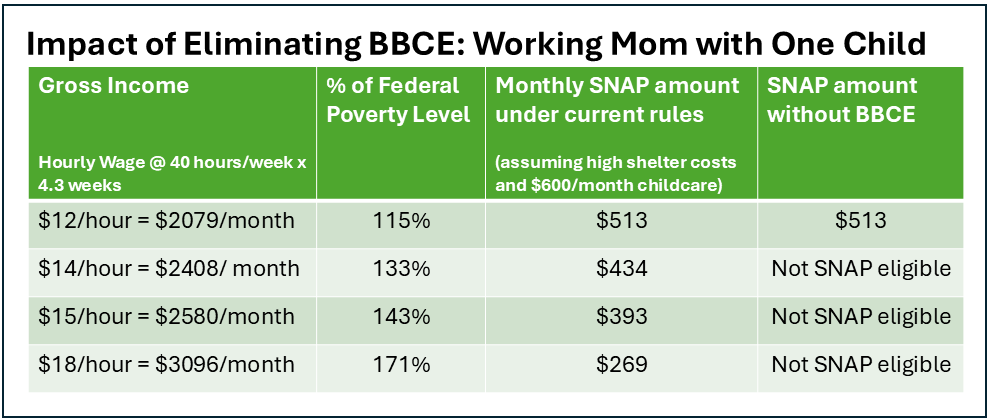
Caitlin lives in New York and works two jobs to provide for her 4-year-old daughter, Natalie. She earns $2,480/month before taxes (about 136 percent of the federal poverty line). Caitlin pays $1,300 in rent on top of child care, car insurance, and gas to get to work. She and her daughter qualify for $434 in SNAP benefits each month. Natalie also participates in WIC, which provides her with $26 per month for fruits and vegetables as part of the WIC food package, which also provides milk, whole wheat bread, beans, and peanut butter. She also receives nutrition education and referrals to other health and social services.
If BBCE is eliminated, Caitlin would be cut off from SNAP because her income is over 130 percent of the federal poverty line. Natalie would also lose adjunctive eligibility for WIC.
Administrative Efficiency and Rising State Costs Under H.R. 1
A USDA study found that BBCE reduces state administrative expenses per case by about 7 percent by simplifying eligibility determinations, eliminating redundant asset verification, and reducing case churn. Under H.R. 1, states now face a 25 percent increase in the administrative cost share, raising each state’s contribution from 50 percent to 75 percent. As a result, any additional administrative burden from eliminating or restricting BBCE will be disproportionately borne by state budgets.
Administrative Efficiency and Rising State Costs Under H.R. 1
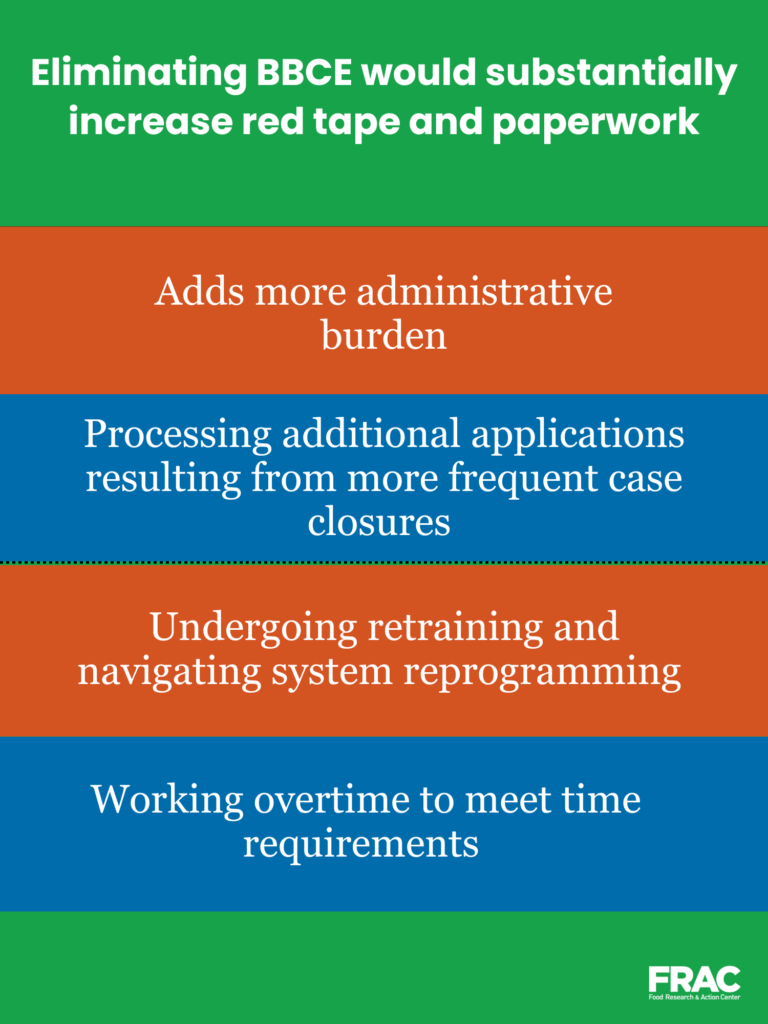
Eliminating BBCE would substantially increase eligibility-determination workers’ responsibilities to include:
- verifying liquid and real assets
- processing additional applications resulting from more frequent case closures
- undergoing retraining and navigating system reprogramming
- working overtime to meet time requirements
Asset verification alone lengthens documentation review, extends interviews, and requires additional follow-up — each of which now carries significantly higher state costs under the 75 percent cost share.
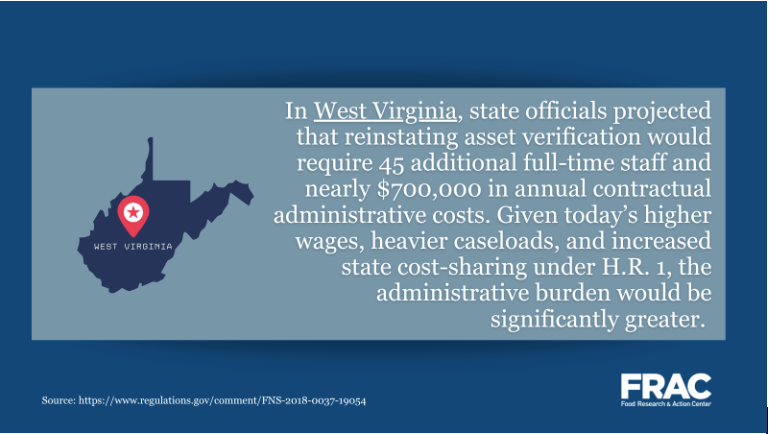
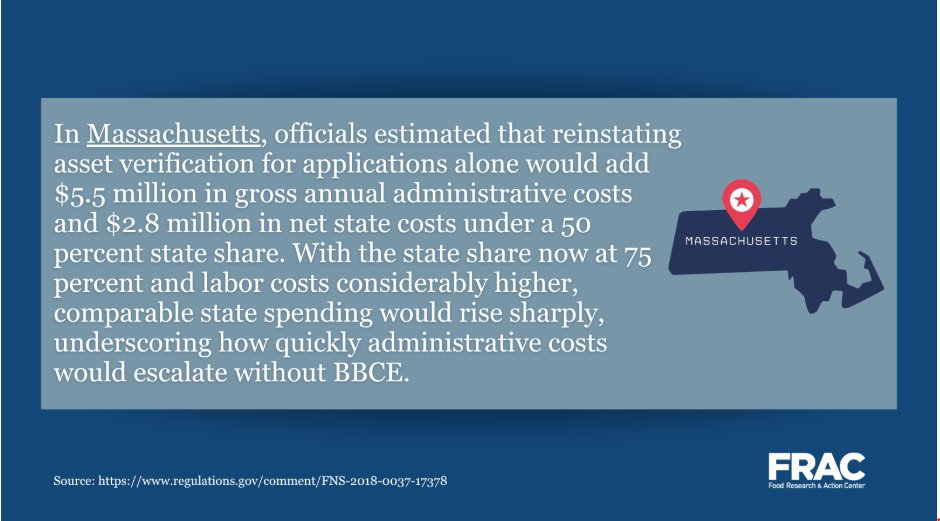
Two state analyses of reinstating asset verification, conducted in 2019 illustrate the magnitude of the administrative and fiscal consequences, which would be even greater today due to H.R.1’s 25 percent increase in administrative expenses. West Virginia would require 45 additional full-time staff, costing nearly $700,000 and Massachusetts would need to add $5.5 million in administrative costs under a 50 percent state share. With the state share now at 75 percent and labor costs considerably higher, adding asset verification would cost even more.
Increased Complexity and Payment Error Risk
Restricting or eliminating BBCE would materially increase eligibility complexity, which is directly correlated with a higher risk of payment errors. Without BBCE, states would need to:
- verify liquid and non-liquid resources
- apply multiple resource exclusions
- reconcile fluctuating account balances
- recalculate eligibility based on minor asset changes
- conduct additional follow-up for missing documentation
Each additional verification layer introduces opportunities for documentation errors, calculation mistakes, and procedural lapses. Several states warned during the 2019 rulemaking process that reinstating asset tests or lowering income thresholds would increase payment errors by lengthening processing times, reducing capacity for quality review, and increasing case closures and reopenings.
Removing BBCE would require more staff and increase the number of overdue applications and recertifications, both of which are strongly associated with higher error rates. SNAP eligibility systems, modernized over two decades to streamline BBCE processes, would face significant operational strain.
These challenges are further amplified by churn, which occurs when modest income shifts repeatedly move households on and off the program. Low-wage workers frequently experience variable hours and irregular pay. Under a strict 130 percent FPL gross income limit, even small temporary earnings increases can trigger full benefit loss. When income drops again, households must reapply, complete another interview, and resubmit documentation.
This churn cycle increases:
- application volume
- recertification workload
- overtime for eligibility staff
- processing delays
- error exposure
- gaps in food access
Each closure and reapplication requires new calculations, new verification, and new documentation review, creating repeated opportunities for administrative errors.
BBCE mitigates churn by allowing eligibility up to 200 percent FPL while preserving the net income test. Benefits phase down gradually rather than ending abruptly, stabilizing agency workload and providing families with more predictable access to food assistance. BBCE provides a more precise evaluation of household needs, especially for working families in high-cost states.
Asset Tests and Economic Mobility
Reinstating asset tests would reverse a long-standing, bipartisan policy choice designed to increase savings and economic mobility. PRWORA significantly narrowed eligibility for many low-income families and increased economic instability for millions of households, especially for children. Although SNAP has long been recognized, on a bipartisan basis, as fundamentally different from cash assistance, it was nonetheless folded into the broader welfare reform agenda advanced under the “Contract with America.”
In the years that followed, states responded to the documented harm and administrative burdens caused by strict asset tests by expanding their use of categorical eligibility. BBCE allowed states to align SNAP with related low-income assistance programs and eliminate punitive asset limits that discouraged families from saving or maintaining stable employment. These updates reduced churn, improved administrative efficiency, and helped families build modest financial security.
Rolling back BBCE today would not only restrict access to nutrition assistance nationwide but also reinstate outdated rules that suppress economic mobility. Before the 1990s, families were often forced to spend down emergency funds or sell modest assets — such as vehicles or small property holdings — to qualify for help. PRWORA itself acknowledged that requiring families to deplete their savings undermines long-term stability.
Asset limits discourage saving and trap families in cycles of crisis. Families experiencing job loss or reduced hours should not be forced to exhaust modest reserves before receiving temporary food assistance. Savings help households maintain transportation, housing, and financial stability, and shorten the time they need SNAP.
USDA research shows that households in states that use BBCE are less likely to cycle on and off SNAP and more likely to maintain bank accounts for emergencies.
BBCE in Action: Joshua
Joshua, a SNAP participant in Washington, aids a child with disabilities at an elementary school. In summers, he works at a golf course snack bar earning $12/hour, but it closes on rainy days. His summer hours are unpredictable, so he saves during the school year to cover rent, beginning the summer with $3,300 in savings. With the elimination of broad-based categorical eligibility, Joshua is no longer eligible for SNAP because his savings exceed the $3,000 asset limit, which previously did not apply in Washington state. When Joshua’s savings fall to $2,500, he will have to re-apply for SNAP again, requiring a new application, interview, document collection, and asset verification, taking up his and a caseworker’s time.
The Proposed Rule’s Impact on Families — The Benefit Cliff
Without BBCE, families approaching 130 percent FPL face a steep benefit cliff: a complete loss of SNAP rather than a gradual reduction. This creates a strong disincentive to accept modest raises, work additional hours, or take overtime. Families may rationally limit earnings to avoid losing food assistance and children’s direct access to free school meals.
BBCE allows benefits to phase down as earnings rise, ensuring total household resources increase with work effort. This structure supports employment. Restricting BBCE would undermine these objectives and reintroduce barriers the policy was designed to eliminate.
Ripple Effect of BBCE Change on Child Nutrition Programs
Cuts to SNAP Hurt Children’s Access to School Meals and Hinder School Meal Operations
As children lose access to SNAP, they also lose automatic eligibility for free school meals, creating a ripple effect across child nutrition programs. A 2019 analysis found that of the 1 million children who would lose automatic access to free school meals, the majority would no longer qualify for federal free school meals at all: 497,000 would qualify only for reduced-price meals, and to receive them, their families would have to navigate the complicated school meal application process. Alarmingly, 40,000 children would not be eligible for federal free or reduced-price school meals, increasing financial burdens on families and hunger during the school day. While USDA’s analysis found that 445,000 children would still be eligible for federal free school meals, they (like the students who would become eligible for reduced-price school meals) would have to submit school meal applications, creating additional paperwork burdens for families and schools.
The Community Eligibility Provision (CEP) allows high-poverty schools to offer all children school meals at no charge. CEP reduces the stigma often associated with participation in school meals and streamlines program administration by relying on direct certification rather than school meals applications to determine federal reimbursement for meals served. Over 55,000 high-poverty schools — more than one out of every two that operate NSLP — implemented CEP in the 2025–2026 school year. To qualify, at least 25 percent of students must be certified for free school meals without an application (referred to as “identified students”). The vast majority are students who are directly certified for free school meals, because their household participates in SNAP.
Identified students are only a subset of students from low-income households in a school, since additional students would be certified for free or reduced-price school meals through the application process. The identified student percentage — the share of enrollment who are identified students — also determines federal reimbursement for meals served in CEP schools. The higher the identified student percentage, the more federal reimbursement CEP schools receive for meals served. The lower the identified student percentage, the less federal reimbursement CEP schools receive for meals served. If BBCE is eliminated, reduced SNAP participation will directly lead to fewer children being directly certified for free school meals, resulting in fewer schools qualifying for CEP and less federal reimbursement for meals served in CEP schools. As schools drop out of CEP, children will lose access to free school meals, meal debt will rise, and nutrition departments will face increased paperwork and administrative obligations.
Since 2019, nine states — California, Colorado, Maine, Massachusetts, Michigan, Minnesota, New Mexico, New York, and Vermont — have adopted Healthy School Meals for All policies, which allow schools to offer all children free school meals regardless of household income. Children in these states who would lose federal free meal eligibility due to BBCE cuts will still have access to free school meals through their state’s policy; however, since Healthy School Meals for All policies maximize federal reimbursement for meals served, as children lose access to SNAP, federal reimbursement for meals served will decrease, shifting a greater portion of the financial burden onto states, putting their Healthy School Meals for All programs at risk.
SNAP Provides Infants and Children Direct Access to WIC
The Special Supplemental Nutrition Program for Women, Infants, and Children (WIC) provides essential nutrition support and health services for pregnant and postpartum women, infants, and children up to age 5 who are nutritionally at-risk and in households with low income. WIC is widely recognized as an important safeguard for protecting and improving the health and well-being of infants and young children, providing the nutritional foundation they need to grow and thrive. Currently, WIC serves more than 6.7 million people. More than 80 percent of WIC participants reported also participating in SNAP, Medicaid, and/or TANF in 2022. Participation in one or more of these programs provides women, infants, and children with automatic income-eligibility for WIC (they must meet all other eligibility criteria as well).This important link, known as adjunctive eligibility, simplifies the application process for families and WIC offices, without sacrificing program integrity.
Eliminating BBCE will create additional paperwork burden for WIC applicants and WIC agencies.
Participation in WIC has been proven to reduce food insecurity and improve health, development, and overall well-being for infants and young children. These benefits have proven economic benefits too, as every $1 in prenatal WIC services saves $2.48 in medical, educational, and productivity costs over a newborn’s lifetime. Yet, only 56 percent of eligible people are participating. Action should be taken to improve access, not create additional paperwork burdens.
Tell USDA to Keep and Protect BBCE
The Trump administration has already gutted SNAP; eliminating BBCE will create further harm for families, children, and schools across the country. This policy, if implemented and combined with the cuts included in H.R. 1, would threaten food security and well-being, and have devastating impacts for children’s health, growth, and development, jeopardizing their future success. We must ensure that Congress and USDA understand the harms that would result from eliminating BBCE. What seems like a dull bit of regulatory policy is a crucial provision that keeps millions of people connected to nutrition benefits.