



Published May 29, 2026
The U.S. Census Bureau recently released new data from the Household Trends and Outlook Pulse Survey (HTOPS), covering various topics including employment, food sufficiency, health insurance, and housing. It offers an important glimpse into the growing challenges many households face in accessing enough food. The June 2025 HTOPS data arrives at a particularly pivotal moment as policymakers debate major changes to federal nutrition programs and federal investments in anti-hunger efforts. The survey, formerly known as the Household Pulse Survey, began during the COVID-19 pandemic, and in 2024, transitioned into a longitudinal design where it surveyed the same people/households over time to observe changes and included new topics to allow for flexible exploration of new issues.
While the survey provides valuable short-term insight into whether families can consistently put food on the table, the data also reinforces a broader reality: Regardless of how hunger is measured, any indication that households are skipping meals, reducing food intake, or struggling to access adequate nutrition is a serious public policy concern. Understanding what HTOPS measures, and what it does not, is essential to interpreting the findings accurately and recognizing why maintaining reliable federal food security data remains critically important.
Food Insufficiency vs. Food Insecurity
To understand how hunger is measured in HTOPS, it is important to recognize the nuances between food insufficiency and food insecurity (see Table 1). HTOPS uses the term “food insufficiency” to indicate whether a household has enough to eat in the short term. In contrast, “food insecurity,” which has been collected in the Current Population Survey Food Security Supplement (CPS-FSS), measures hunger in the long term at two levels of severity and accounts for the inability of household members obtaining food due to lack of funds and resources.
Table 1: Distinctions between Food Insufficient and Food Insecurity Measures
Food Insufficient | Food Insecurity | |
Definition | Households sometimes or often did not have enough to eat. | Households were, at times, unable to acquire adequate food for one or more household members because the households had insufficient money and other resources for food. Food insecurity is measured at two levels of severity:
|
Reference Period | Last 7 days | 12 months or 30 days |
Question | “In the last 7 days, which of these statements best describes the food eaten in your household? Select only one answer: 1) Enough of the kinds of food (I/we) wanted to eat;
2) Enough, but not always the kinds of food (I/we) wanted to eat; 3) Sometimes not enough to eat; 4) Often not enough to eat.” | A scale that consists of 10 survey questions for all households and an additional eight questions for households with children. The questions cover a range of severity of conditions and behaviors that characterize food insecurity. |
Classification | Responses of (3) or (4) are classified as food insufficient. | Households that affirm three items are classified as food- insecure. Adult-only households that affirm six items, and households with children that affirm eight items, are classified as very low food-secure. |
Source: Food Security in the U.S. — Measurement, USDA Economic Research Service
Overall, food insufficiency means that households sometimes or often did not have enough to eat. It gives us insight into how often households have food for periods at a time but does not provide the same complete picture as thorough food insecurity measures.
Food Insufficiency Among All Households
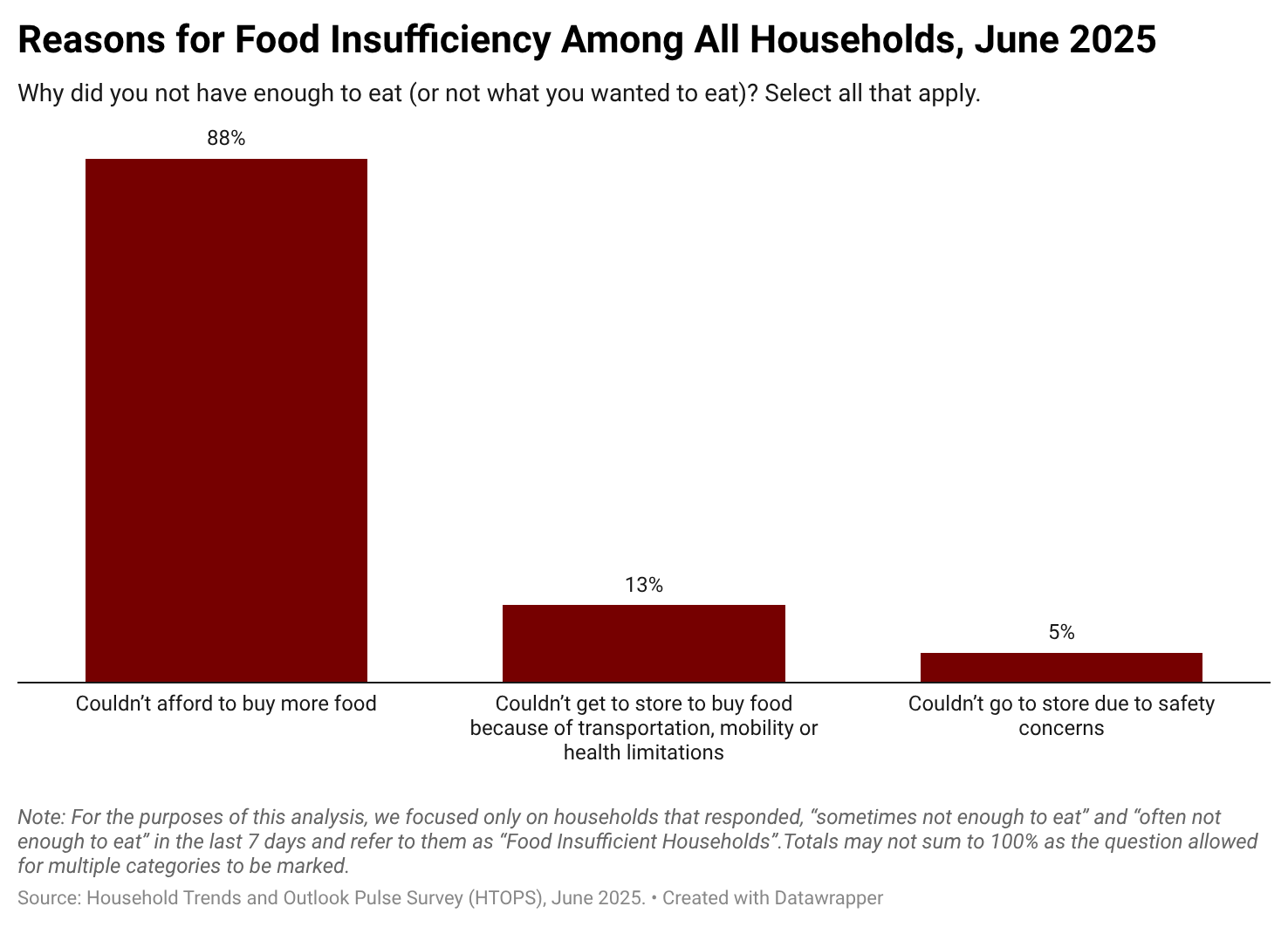
The June 2025 HTOPS data estimates that 18 million households experienced food insufficiency, defined as answering “yes” to questions about “sometimes” or “often” not having enough to eat. When looking at the reasons why, the data revealed:
-
- More than three quarters could not afford to buy more food.
- About 1 in 8 households said they could not get to a store due to transportation, mobility, or health limitations.
- About 1 in 20 households said they could not go to the store because of safety concerns.
Food Insufficiency Among Families With Children
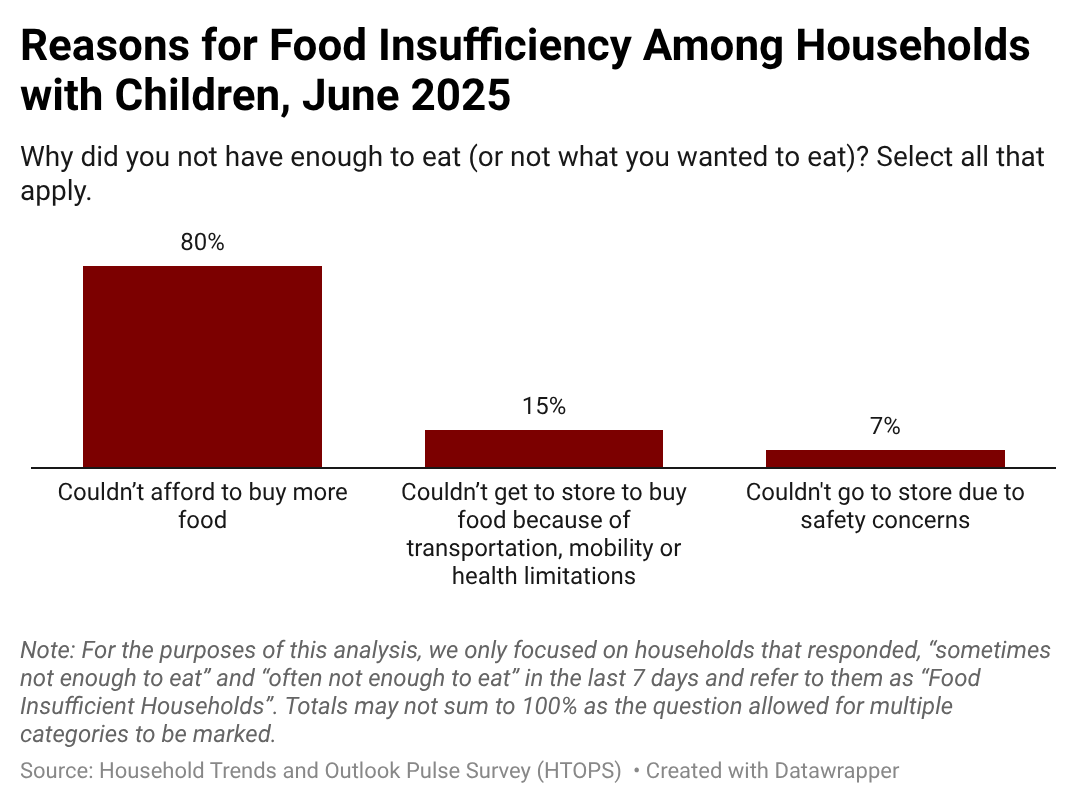
Food insufficiency is prominent in households with children. About 8 million households with children, or 21 percent of all households with kids, sometimes or often did not have enough to eat (see Table 2).
- More than three quarters of households with children reported “sometimes” not having enough to eat due to grocery prices.
- Nearly 1 in 5 households with children could not get to a store due to transportation, mobility, or health limitations.
- About 1 in 10 households with children could not go to a store due to safety concerns
Food is essential for any child’s development as childhood food insecurity and malnutrition can have lasting impacts into adult life. Research has shown that children as young as 3 who lived in food-insecure households, showed developmental delays in their social — emotional and self-regulatory — skills. Obesity and poor cardiovascular health can show up during young adulthood due to poor nutrition in the early years.
SNAP and Food Security
Considering that food insufficiency measures whether a household generally has enough to eat, it is an indicator of whether a household is closer in severity to very low food security than to overall food insecurity. Therefore, food insufficiency can indicate whether a household has experienced disrupted eating patterns. Research has shown that unstable food access due to poverty or lack of access to food, can shape disordered eating patterns that can affect a person’s nutrition and overall health.
SNAP has proven to reduce food insecurity by helping families afford groceries to frequently have nutritious food on the table. This is essential for households with children, as children with access to SNAP have shown improved health outcomes by reducing the likelihood of developing chronic conditions such as heart disease and obesity that can later carry into adulthood. When looking at SNAP usage among households, HTOPS data shows similar rates of food insufficiency for households with and without children.

A reason why households may still not have enough to eat even with SNAP benefits, can be partially due to inadequate benefits that severely limit the program’s ability to do more to improve food security and health. The adequacy of SNAP benefits to meet family needs and alleviate hunger will only be negatively impacted by the recent changes to SNAP in the budget reconciliation law, H.R. 1.
SNAP benefits are calculated based on the Thrifty Food Plan (TFP), which “estimates the weekly cost of a diet designed to meet nutritional needs at minimal expense.” It takes into consideration current dietary guidelines, food consumption data, and food prices. Prior to H.R. 1, the average monthly SNAP benefit was about $6.20 per person per day. However, H.R.1 negatively changes how benefits are calculated by:
- blocking future increases to monthly SNAP benefits, gradually reducing benefits for all participants;
- blocking modifications to monthly SNAP benefits due to inflation and other economic pressures, essentially ignoring factors that can increase grocery prices; and
- preventing meaningful adjustments such as reviewing the Thrifty Food Plan every five years for adequacy.
H.R. 1 weakens the Thrifty Food Plan and decreases funding from SNAP, all while implementing new work requirements and time limits that will create new groups of ineligible people and make it harder for individuals and families with children to continue being eligible for SNAP. This will undoubtedly increase the number of households experiencing food insufficiency and negatively impact their health.
HTOPS Provides Critical Food Security Information, but It Is Not Enough
The recent HTOPS data revealed that affordability was the main issue for both types of households, unsurprising given the steep price increases for basic food items such as chicken breast, ground beef, and orange juice. However, this survey does not give us the full picture. Since HTOPS was designed to provide data with a short turnaround time, it faces barriers such as limited sample size and low response rates that may affect its comparability to other data sources and generalizability to the U.S. population.
To truly assist families in need, policymakers must be able to draw on data sources that showcase the full picture of hunger in the U.S. The Food Security Supplement (FSS) to the Current Population Survey (CPS) is the only federal-level data set that is:
- collected annually
- nationally representative
- has a large sample size
- provides robust prevalence and state-level estimates
- uses the full 18-item food security questionnaire
- captures both adult and child experiences
Unfortunately, the Trump administration discontinued the Food Security Supplement in September 2025. The federal government claims it is redundant and expensive, implying that other data sets fully capture food insecurity in the U.S. However, this is not accurate. Other data sets:
- have altered their methods, including their questionaries by removing food security questions such as in the National Health Interview Survey (NHIS);
- are inconsistent with their data releases;
- do not survey both adults and children;
- do not provide national and state level estimates; and/or
- do not have a large enough sample size.
Altering, pausing, or terminating federal data makes it difficult for policymakers to access timely and accurate data that inform decisions, and deprives the general public of knowing how prevalent hunger is in America. Restoring full food security data collection is of the utmost importance.
Take Action
As the wealthiest nation on earth, any level of hunger is unacceptable. Cutting funding for programs, like SNAP, that have proven to help reduce hunger will only worsen the hunger crisis in the U.S.
As the Senate prepares their draft of the Farm Bill, Members need to understand the cost of hunger to their communities, towns, and cities. Reach out to your representatives and make it clear to them that failing to address the harmful SNAP cuts in H.R. 1 will increase food insecurity and hardship for families in their state, and nationwide.