

During the 2025–2026 school year, a record 55,362 schools offered breakfast and lunch to all their students through the Community Eligibility Provision (CEP), according to FRAC’s latest report, Community Eligibility: The Key to Hunger-Free Schools.
This report analyzes CEP adoption—nationally and for each state and the District of Columbia—in the 2025–2026 school year.
Key Findings
-
- The number of schools participating in CEP increased in the 2025-2026 school year, but the pace of growth slowed substantially compared with recent years.
- 55,362 schools adopted CEP, an increase of 1,128 schools (2.1 percent) from the previous school year.
- 74.9 percent of eligible schools adopted CEP.
- 27.6 million children attended a CEP school, an increase of 368,019 children (1.4 percent) from the previous school year.
What Is The Community Eligibility Provision?

The Community Eligibility Provision (CEP) allows high-need schools to offer breakfast and lunch at no charge to all students. CEP is a key step towards Healthy School Meals for All – offering free school breakfast and lunch to all students, regardless of their household income.
- Which schools can participate?Any school district, group of schools in a district, or school with 25 percent or more “identified students” – children who are certified eligible for free school meals without a school meals application – can choose to participate. Identified students are children who are eligible for free school meals due to participating in another means-tested federal program, such as the Supplemental Nutrition Assistance Program (SNAP), or in most states, Medicaid, or because they are in a specific eligibility category, such as being in foster care, Head Start, or are experiencing homelessness.
- How are community eligibility schools reimbursed?Rather than collecting school meal applications, CEP schools are reimbursed based on the percentage of students that are automatically eligible for free school meals without an application, called the identified student percentage (ISP).
Identified students are a subset of children who would be eligible for free or reduced-price school meals if the school collected meal applications. For that reason, a multiplier of 1.6 is applied to the ISP to calculate the percentage of meals reimbursed at the federal free rate. The remainder of meals served are reimbursed at the lower, federal paid rate.
The 2025-2026 school year saw the lowest rate of CEP growth in the program’s history. Without additional investments in CEP, including raising the multiplier, many schools, especially those with lower ISPs, simply cannot adopt CEP. As a result, far too many students are still missing out on the educational and health benefits of free school meals.
- What's driving CEP adoption?
CEP adoption is highest in states with policies that support school nutrition finances, including the nine Healthy School Meals for All states and Oregon, which provides state funding to help offset the cost of implementing CEP in schools that receive less than full federal free reimbursement. Outside of state policies, this year’s growth was largely driven by states initiating Medicaid Direct Certification in the 2024–2025 school year (Maine, New Jersey, Idaho, and Arkansas).
Directly certifying children as eligible for free school meals based on their participation in another means-tested program, such as SNAP or Medicaid, is the basis for CEP eligibility and federal reimbursement.
While most students are directly certified for free school meals through household participation in SNAP, the U.S. Department of Agriculture’s Medicaid Direct Certification Demonstration Project has helped link eligible children to free or reduced-price school meals, and has supported schools’ ability to implement CEP. As of the 2025–2026 school year, 44 states use Medicaid and household income data to directly certify children for free or reduced-price school meals. This mechanism – Medicaid Direct Certification – is a catalyst for CEP adoption, increasing school’s ISPs and, in turn, the amount of federal reimbursement CEP schools receive.
- Why Is CEP Growth Slowing?Seventeen states and the District of Columbia decreased the total number of schools implementing CEP in 2025–2026 compared to 2024–2025. While declining student enrollment and resulting school closures contributed to these losses, low or decreasing ISPs and longstanding barriers to CEP participation—particularly inadequate federal reimbursement—likely also played a role. These challenges will be compounded by the 2025 budget reconciliation law (H.R. 1), which enacted severe and unprecedented cuts to SNAP that have already caused millions of people to lose nutrition benefits, threatening schools’ ability to qualify for and sustain CEP participation.

FRAC’s CEP Database
Search FRAC’s CEP database to determine which schools in your community or state are eligible for CEP, and which eligible schools are participating in CEP. The database holds data for 50 states and the District of Columbia for the 2025–2026 school year.
What Congress Must Do to Protect and Expand CEP
Congress must repeal cuts to SNAP by passing the Restoring Food Security for American Families and Farmers Act of 2025 (H.R. 6088/S. 3281). Children and families are already struggling with the loss of SNAP benefits amid record high food and living costs. As more children lose access to SNAP and are no longer directly certified for free school meals, schools’ ability to implement CEP and offer all children healthy school meals at no cost will diminish, resulting in increased hunger at school and at home.
Congress must also strengthen school meal programs by investing in the tools that make them work. That includes raising the CEP multiplier, expanding direct certification and categorical eligibility to automatically qualify children for free school meals, increasing federal reimbursement rates, supporting schools’ capacity for local procurement and scratch cooking, and ultimately, making Healthy School Meals for All a reality nationwide.
Children can’t wait. Congress needs to act now to ensure that every student in every state has access to the nutrition they need to thrive in the classroom and beyond.


Tell Congress to Reverse SNAP Cuts and Protect Access to Free School Meals
The deep SNAP cuts in H.R. 1 threaten school meals. Use the FRAC Action Network to urge your Members of Congress to protect these critical programs.
Community Eligibility: The Key to Hunger-Free Schools 2026
Read the report
Community Eligibility: The Key to Hunger-Free Schools 2025
Read last year's report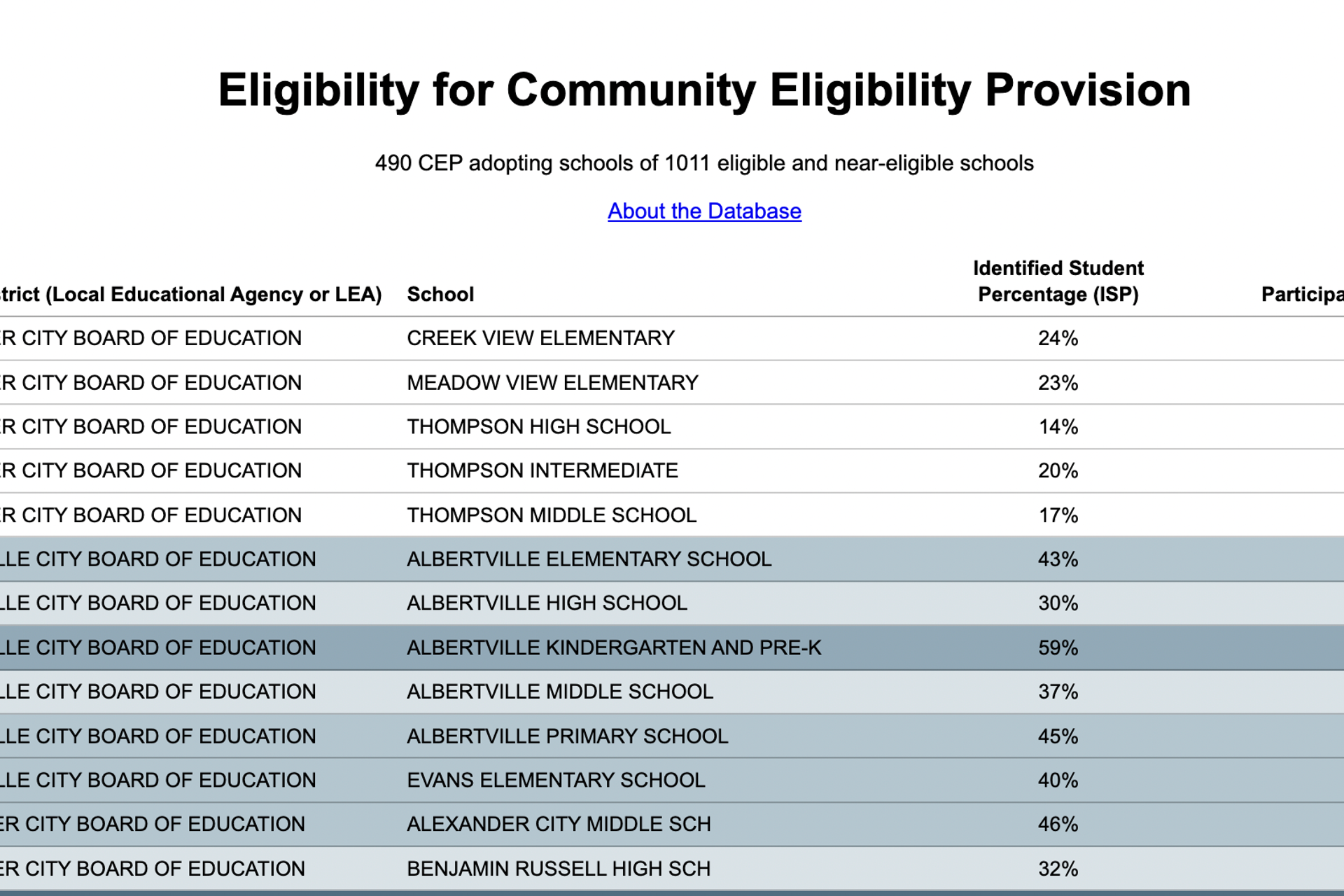
See if your school is eligible!
CEP Database