



Published April 1, 2026
Updated June 18, 2026
The budget reconciliation law, also referred to as H.R. 1,, marks a significant departure from the longstanding structure of the Supplemental Nutrition Assistance Program (SNAP), one of the federal government’s most effective tools for reducing hunger and promoting economic stability. The law weakens multiple components of the critical support system shifts substantial financial responsibility from the federal government to states, and fundamentally alters SNAP’s financing model. Most notably, it requires states, for the first time in the program’s history, to cover a share of SNAP food benefit costs rather than limiting their contributions to administrative expenses.
These changes rest on a flawed premise: that SNAP payment error rates provide a simple, controllable, and reliable measure of state performance. In practice, error rates reflect an extraordinarily complex administrative process carried out by skilled eligibility workers under shifting rules, constrained resources, and evolving federal guidance. By tying punitive cost-sharing requirements to these metrics, while simultaneously reducing federal administrative support, H.R. 1 reflects a fundamental misunderstanding of how SNAP operates and how quality control systems actually function.
SNAP Administration and Quality Control Overview
SNAP operates as a federal-state partnership jointly administered by the U.S. Department of Agriculture’s Food and Nutrition Service (USDA FNS) and state agencies. FNS establishes program regulations and oversees compliance, while state agencies determine household eligibility, calculate benefit amounts, and issue benefits. To safeguard program integrity, both levels of government conduct independent quality control (QC) reviews that assess whether eligibility determinations and benefit amounts were correct. SNAP has one of the most rigorous quality control systems in the federal government.
QC reviews evaluate a household’s eligibility and benefit level at a specific point in time. Reviewers examine financial and nonfinancial factors — such as household composition, income, and deductions — under statutory and regulatory standards, including FNS-approved waivers and state options. All QC activities must adhere to the procedures in the Quality Control Review Handbook (FNS Handbook 310) and related policy memoranda, which prescribe how reviewers examine cases, calculate errors, and report findings.
Each year, states review a statistically valid random sample of participating SNAP households and submit results to FNS. FNS independently re-reviews a subsample to validate state findings and combines both sets of results to calculate state and national error rates using weighted statistical methods. The Food Stamp Act of 1977 established this system not as a punitive tool, but as a diagnostic mechanism to promote accuracy, identify systemic issues, and guide program improvement.
QC Review Process and Error-Rate Calculation
Under the QC system, state agencies randomly select approved cases each month and conduct detailed reassessments of eligibility and benefit determinations. QC reviewers spend substantially more time per case than frontline eligibility workers and often rely on data sources not available during routine case processing. They must also maintain deep technical knowledge of SNAP rules that affect case accuracy. States extrapolate findings from the sampled cases to their entire caseload.
USDA staff independently re-examine a subset of state-reviewed cases and may revise state determinations when they identify uncorrected errors or determine that flagged payments were accurate. Based on these reviews, USDA calculates three separate error components: benefits issued to ineligible households, overpayments to eligible households, and underpayments to eligible households. USDA adds the absolute value of these components, without netting them against one another, to determine a state’s payment error rate.
For example, if a state issued $10 million in benefits in a month, paid $200,000 to ineligible households, overpaid eligible households by $300,000, and underpaid other households by $100,000, its payment error rate would be 6 percent, not 4 percent. The rate excludes benefits improperly denied altogether, even though such denials may reflect serious administrative failures.
Although SNAP payment error rates are often treated as a proxy for overall program performance, they measure only payment accuracy within reviewed cases and do not capture several other important dimensions of program integrity and effectiveness. Specifically, SNAP error rates do not measure:
- access or participation barriers
- timeliness of case processing
- program abuse
As a result, relying on payment error rates as a comprehensive performance metric can obscure other critical aspects of program administration and lead to misleading conclusions about program effectiveness.
Sanctions and Penalties
States whose error rates exceed statutory thresholds face USDA sanctions, which escalate as error rates diverge further from the national average. States may receive waivers in limited circumstances or reinvest portions of penalties in USDA-approved corrective measures, but these funds do not receive federal matching.
H.R. 1 intensifies this already demanding framework by linking error rates to mandatory state cost-sharing for SNAP benefits — while also increasing the state share of administrative expenses from 50 percent to 75 percent. These overlapping requirements amplify fiscal risk and expose states to significant volatility driven by factors often beyond their control.
Factors Affecting Payment Error Rates
Payment error rates are highly sensitive to operational conditions. The most significant increases often follow flawed rollouts of new eligibility systems, which can introduce errors directly while also overwhelming staff responsible for identifying and correcting them. Staffing shortages, early retirements, and economic downturns further reduce administrative capacity and increase vulnerability to error.
Case complexity is another critical factor. Households with stable, fixed incomes — such as older adults receiving retirement benefits — rarely generate payment errors. By contrast, households with fluctuating earnings or changing household composition require frequent reassessments and carry a much higher risk of error. States and localities serving a disproportionate share of these cases typically report higher error rates, even when administrative performance is strong.
State policy choices also shape error rates. Eliminating the asset test removes an entire category of potential errors. Longer certification periods paired with interim reporting can reduce risk by limiting how often eligibility factors must be reverified. Conversely, extensive verification requirements and inaccurate or unreliable data matches often divert staff time toward documentation, increasing technical errors without improving substantive accuracy.
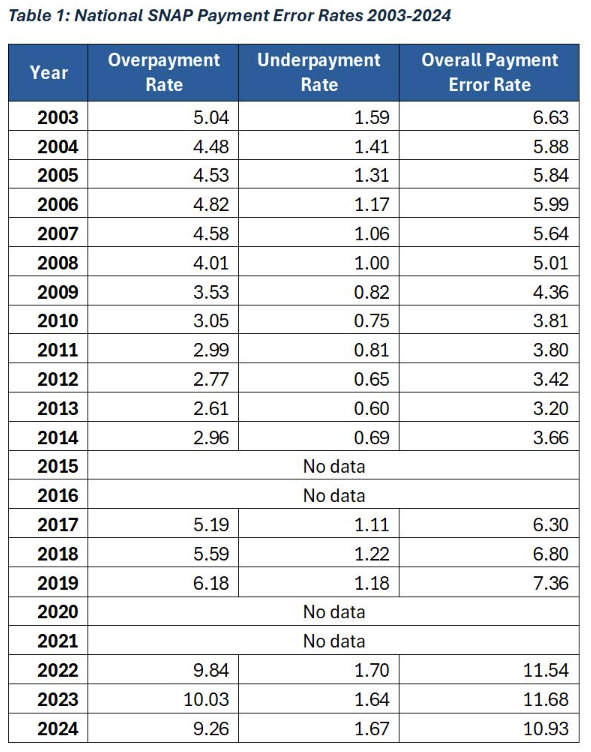
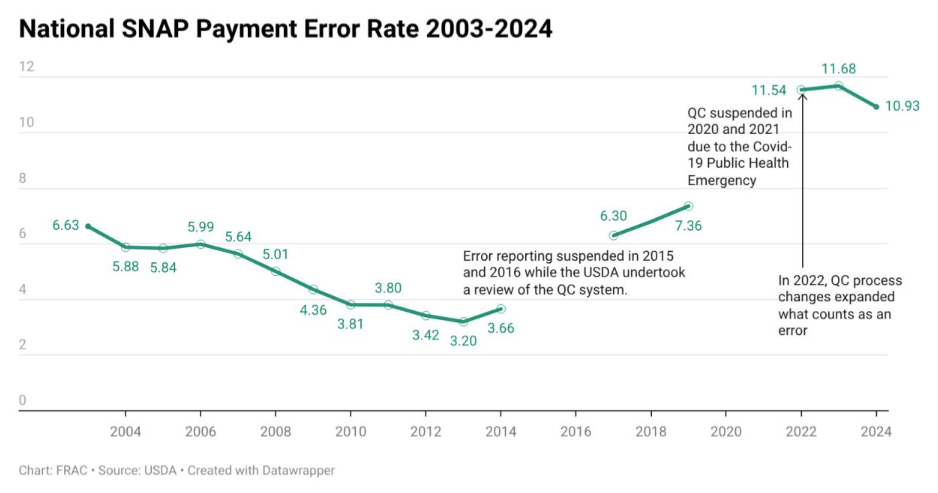
Federal measurement standards further complicate interpretation. USDA has periodically changed what qualifies as an error, including its 2022 decision to begin counting certain “technical errors” — paperwork deficiencies in otherwise accurate cases. This change caused error rates to rise in some states even though households received the correct benefit amounts and were substantively eligible.
Payment Error Examples
- An eligibility worker correctly process an application by conducting the interview, requesting verification, and confirming household composition, residency, and other factors in a timely manner. During a subsequent QC review, the case is cited as erroneous solely because a landlord verification form lists the rent amount, landlord name, address, and client information but omits the landlord’s phone number. Even though the missing phone number has no effect on eligibility or the benefit amount, QC standards still count the case as an error.
- An eligibility worker correctly determines a household’s eligibility and benefit amount, and the household timely submits its required interim report showing no change. Because the office is severely understaffed, the worker cannot process the report by the due date, and later confirms that eligibility and benefit amounts were accurate for every month. Under USDA’s revised QC rules, reviewers nonetheless count all benefits issued after the due date as payment errors solely because the report was not processed on time, even though the delay resulted from staff capacity constraints rather than any substantive error.
The SNAP Payment Error Tolerance Threshold
The error tolerance threshold, the dollar value used in determining whether a payment discrepancy is included in the SNAP payment error rate, plays a significant role in shaping reported error rates. Established in statute to distinguish material payment errors from trivial discrepancies, the threshold provides a standardized measurement rule for the QC system. Currently set at $58, the threshold has been periodically adjusted by Congress and USDA, most notably during the American Recovery and Reinvestment Act of 2009 and in subsequent years. Since 2014, USDA has adjusted the threshold annually to reflect changes in the Thrifty Food Plan.
Having this threshold reduces measured error rates by excluding immaterial discrepancies and, critically, by conserving scarce administrative capacity. Very small payment differences often require extensive documentation and follow-up despite having no meaningful impact on household well-being or program integrity. Excluding errors below the $58 threshold allows eligibility and QC staff to focus on substantive eligibility accuracy, timely case processing, and service quality, rather than expending resources on negligible dollar variations.
In addition to reducing administrative burden, the threshold improves statistical reliability by minimizing noise from trivial dollar discrepancies that do not meaningfully reflect program performance.
Efforts to eliminate or weaken the error tolerance threshold reflect a misunderstanding of both administrative realities and sound program management. Removing this safeguard would increase workload, distort performance measures, and strain state administrative systems without improving accuracy or outcomes.
A Warning to Policymakers: Listen to the Experts
SNAP quality control is not a simple compliance exercise; it is a highly technical, labor-intensive system carried out by trained eligibility workers operating under complex rules, evolving guidance, and finite resources. Policymakers are not present when eligibility staff navigate fluctuating incomes, large caseloads, system failures, or contradictory policy directives, just as legislators are not in the operating room when a surgeon performs cardiac surgery. Yet H.R. 1 injects new pressure into this system without regard for operational consequences.
By layering mandatory benefit cost-sharing, higher administrative cost burdens, the suggested elimination of pragmatic safeguards like the error threshold, and the loss of experienced federal technical assistance due to significant staff attrition and pending USDA regional office relocations, H.R. 1 places states in an impossible position. The likely result is not improved accuracy but greater instability, reduced access, and increased hunger — borne by the same constituents policymakers purport to serve.
In a program this complex, evidence-based policymaking requires listening to those who do the work. Ignoring operational expertise will not discipline SNAP; it will damage it —financially, administratively, and morally.