


One of the most harmful changes in the budget reconciliation law (H.R. 1) is the shift in SNAP’s funding structure, requiring states — for the first time in history — to pay a portion of food benefit costs, not just administrative expenses.
The state cost-share breaks the long-standing model under which the federal government covered 100 percent of SNAP food benefits. Starting in fiscal year (FY) 2028, state contributions will be tied to their payment error rates — a metric that is often unstable and misleading. Based on FY 2024 data, 44 states would face new financial burdens under this change. See further analysis here.
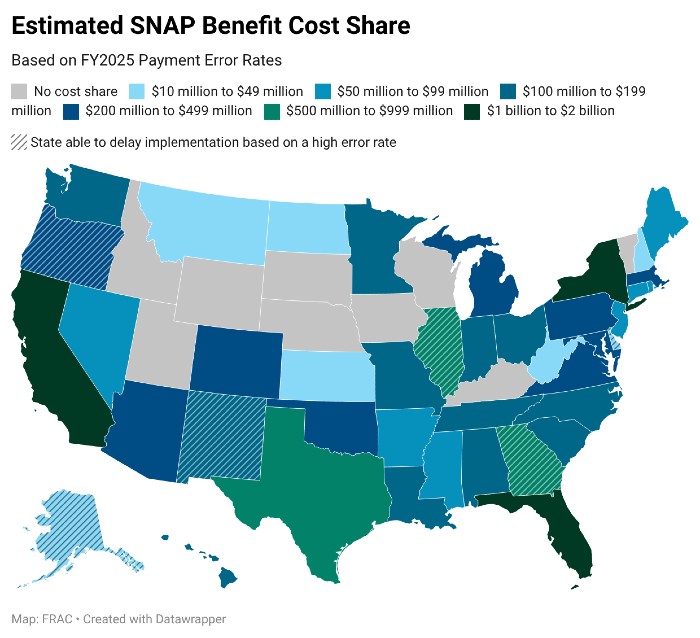
UPDATED: Table: Economic Strain and New SNAP Cost-Shifts Under H.R. 1
On June 24, 2026, the USDA releases state SNAP error rates for Fiscal Year (FY) 2025. See how your state could be impacted in FRAC’s updated table.
H.R. 1’s Cost-Share Threatens State Budgets & The Future of Food Assistance
These costs shifts will force states to make the impossible choices of cutting eligibility for families, veterans, older adults, and people with disabilities; raising taxes; or cutting other essential services. Some states will be unable to absorb these costs at all, putting the future of SNAP itself at risk.
Smaller or rural states face disproportionate financial risk.
How Error Rates Determine H.R. 1’s SNAP Benefit Cost-Share
H.R. 1 requires states to contribute to the benefit cost based on their SNAP payment error rate.
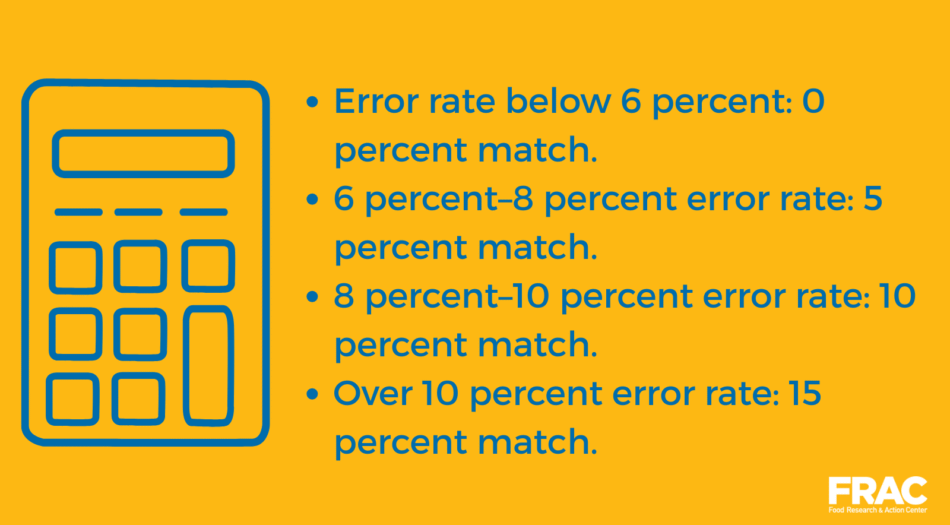
These rates will be based on the most recent available data, meaning FY 2026 data will dictate FY 2028 cost-sharing. Many states currently on the margin could easily fall into higher-cost brackets over time, especially as administrative costs rise and federal support wanes.
What Is a Payment Error?
Payment error rates measure how accurately states determine eligibility and benefit amounts, including both overpayments and underpayments. Errors are administrative mistakes, and H.R. 1’s cost-share penalizes states for these inaccuracies — often minor mistakes made by caseworkers or recipients navigating a complex system.
Exceptions to the Rule
In limited cases, states can delay their SNAP benefit cost-share obligation.
If a state has a higher payment error rate — 20 percent or higher, when multiplied by 1.5 — in either FY 2025 or 2026, it can push back the start of its cost-share to FY 2029 or 2030, respectively.
This delay is a one-time option; states can only take advantage of it once, based on either FY 2025 or FY 2026 data, not both.
This exception has raised concerns around parity, while also perversely incentivizing states to maintain higher error rates to postpone their cost-share obligations.
How States Can Prepare

Fully fund state agencies to have administrative capacity

Document challenges with USDA’s nontransparent systems

Engage state fiscal offices now

Improve IT and support workers
SNAP Cost-Shifts Will Increase Hunger, Strain State Budgets, and Deepen Economic Risk
Read moreTable: Economic Strain and New SNAP Cost-Shifts Under H.R. 1 Across All States
Learn moreShifting the Burden: How the Recently Passed Budget Reconciliation Package Reshapes SNAP and Strains State Budgets
Read moreThe Deep Cost of President Trump's and Republicans' SNAp Cost-Share: 10 Things to Know
Read more