

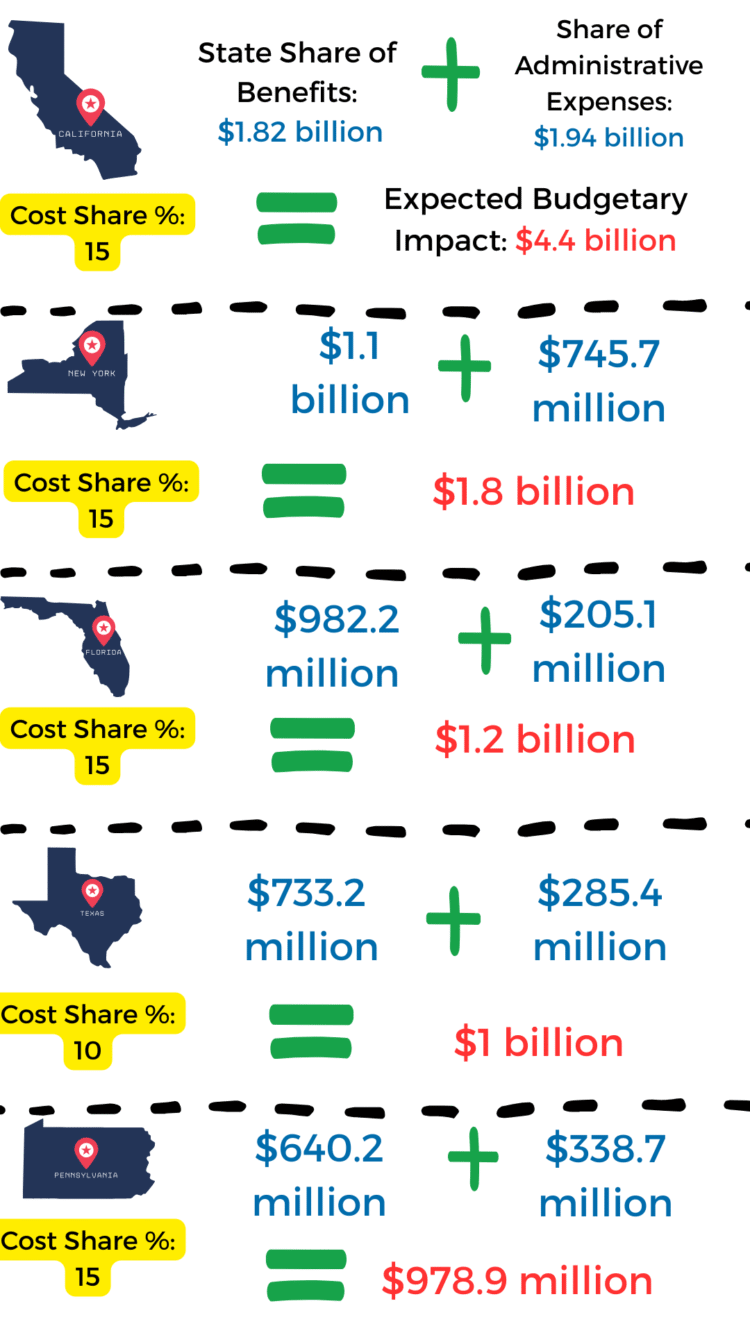
Beginning in FY 2027, the federal government will reduce its share of SNAP administrative costs from 50 percent to 25 percent, requiring states to shoulder the remaining 75 percent.
States Will Be Forced to Make Impossible Choices
This significant cost shift will strain already tight state budgets, reduce the ability of agencies to manage the program effectively, and likely result in service delays and staffing reductions.
Every state will feel the fiscal pain of H.R. 1’s cost shift, which will force local leaders to make painful tradeoffs between essential services and rising administrative demands. Some states will be unable to absorb these costs at all, putting the future of SNAP itself at risk.
How H.R. 1 Cost Shifts Impact Most Populous States
Impact on Counties Administering SNAP
In 10 states — California, Colorado, Minnesota, New Jersey, New York, North Carolina, North Dakota, Ohio, Virginia, and Wisconsin — county governments administer SNAP, covering 34.3 percent of all participants (14.6 million individuals).
Counties in these states collectively invest an estimated $1.7 billion annually in local funding for SNAP administration. In New York, North Carolina, and New Jersey, counties must cover the full 50 percent non-federal match. In California, Colorado, Minnesota, Ohio, Virginia, and Wisconsin, the state shares this obligation with counties. Only North Dakota fully funds the non-federal match at the state level.

How States & Counties Can Prepare

Begin cost forecasting

Coordinate with county administrators

Prepare testimony on impact for legislative budget summaries
Fact Sheets & Resources
SNAP Cost-Shifts Will Increase Hunger, Strain State Budgets, and Deepen Economic Risk
Read moreTable: Economic Strain and New SNAP Cost-Shifts Under H.R. 1 Across All States
Learn moreCuts to SNAP Threaten the Child Nutrition Programs
Learn more