

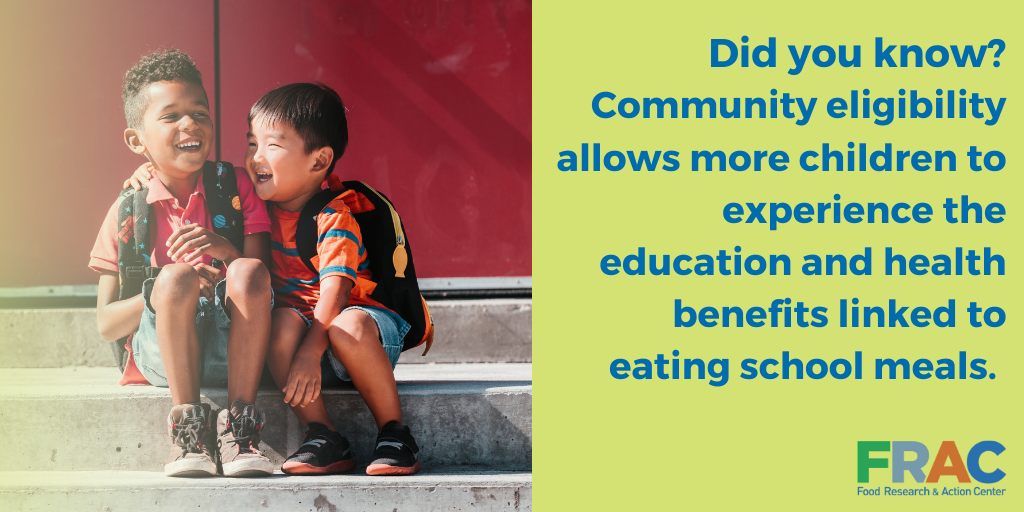
The Community Eligibility Provision (CEP) allows high-poverty schools and districts to provide breakfast and lunch at no charge to all students. Community eligibility reduces administrative paperwork; increases school meal participation; eliminates stigma; and makes it easier to implement Breakfast in the Classroom and other innovative breakfast models. Community eligibility is a win for everyone — administrators, students, families, and school nutrition staff.
Participation in community eligibility has grown each year as more schools learn about its many benefits. In the 2022-2023 school year:
- 40,235 schools in 6,419 school districts participated.
- 19.9 million children attended community eligibility schools.
- 82 percent of eligible schools adopted community eligibility.
Still, many eligible schools have not yet implemented community eligibility and should consider it for the coming school year.
For questions regarding Community Eligibility or FRAC’s Community Eligibility Database, please contact Erin Hysom at EHysom@frac.org or Crystal FitzSimons at CFitzSimons@frac.org.
FRAC’s Community Eligibility Grouping Tool and Financial Calculators
|
- What is Community Eligibility, and how does it work?Community eligibility allows high-need schools to offer breakfast and lunch to all students at no charge. Starting October 26, 2023, any school district, group of schools in a district, or school with 25 percent or more “identified students” – children who are certified eligible for free school meals without a household application – can choose to participate.
Identified students include children directly certified through data-matching because their households receive the Supplemental Nutrition Assistance Program (SNAP), Temporary Assistance for Needy Families (TANF), or the Food Distribution Program for Indian Reservations (FDPIR), and in some states, Medicaid benefits, as well as children who are certified for free meals without an application because they are homeless, migrant, enrolled in Head Start, or in foster care.
Because school districts and schools participating in community eligibility use direct certification to determine their identified student percentage (ISP), they no longer have to collect meal applications each year from students and families to provide free meals to all students.
- FRAC’s 2022-2023 Community Eligibility DatabaseTo find out which schools and districts participate and qualify for community eligibility in your area, see FRAC’s Community Eligibility Database.
- Benefits of Community Eligibility
- Less administrative work—schools no longer have to collect and verify school meal applications.
- Increased Participation— schools participating in community eligibility found a 6.8 percent increase in school lunch participation and a 12.1 percent increase in school breakfast participation in the first year of implementation, according to a recent U.S. Department of Agriculture (USDA) community eligibility study on school year 2016–2017.
- Facilitates implementation of innovative breakfast service models—since schools don’t have to collect school meal fees or count each meal served by fee category, it is easier to implement of breakfast in the classroom and “grab and go” service models that can boost breakfast participation further.
- Improves the financial viability of school nutrition programs—when participation increases, school districts can take advantage of economies of scale, and reinvest any additional revenue to improve nutritional quality and provide staff training.
- Eliminates unpaid meal fees—when all children eat at no charge, the school district does not have to collect unpaid fees from families.
- Making Community Eligibility a Reality for Your DistrictThe ISP is multiplied by 1.6 to determine the percent of meals reimbursed at the free rate. The remaining meals are be reimbursed at the paid rate. For example, schools with an ISP of 50 percent will have 80 percent of their breakfasts and lunches reimbursed at the free rate, and 20 percent at the paid rate. Those with an ISP of 62.5 percent or higher will receive the free rate for 100 percent of their meals served.
Thousands of schools across the country with an ISP below 62.5 have implemented community eligibility successfully. Below resources to help school districts determine if community eligibility is a viable option.
- Implications for Eliminating School Meals ApplicationsTo support community eligibility implementation, federal agencies have provided guidance for federal educational funding sources that traditionally relied on free and reduced-price school meal information, such as Title I or E-Rate. Some states base their education funding on free and reduced-price eligibility, which requires schools in those states to collect an alternative income form from the students who are not certified for free school meals without an application. Check out these resources to learn more:
- Understanding the Relationship Between Community Eligibility and Title I Funding
- Summary of State Education Funding Policies (pdf)
- The Community Eligibility Provision: Alternatives to School Meal Applications
- US Department of Education Title I Guidance for Community Eligibility Schools
- Federal Communications Commission E-Rate Guidance for Community Eligibility Schools
- Outreach Resources for Community EligibilityFRAC’s communications resources can help advocates get the word out to districts and parents about the benefits of community eligibility.
- FRAC's Community Eligibility Report
- USDA Community Eligibility ResourcesCheck out USDA’s Community Eligibility Provision Resource Center for webinars and additional resources on community eligibility.
- FRAC Community Eligibility Webinars
- Medicaid Direct Certification Demonstration ProjectThe Healthy, Hunger-Free Kids Act of 2010 authorized demonstration projects to use Medicaid data for direct certification. The statute requires that students be enrolled in Medicaid and belong to a family whose income, as defined by Medicaid, is below 133 percent of the federal poverty level in order to use Medicaid data to directly certify a student to receive free school meals.
In 2016, the U.S. Department of Agriculture issued a request for proposals for states to be included in a demonstration project that allowed direct certification for free and reduced-price school meals using Medicaid income data.
In 2022, USDA approved 12 states to begin Medicaid Direct Certification in the 2023-2024 school year, bringing the total number of states participating in the demonstration project to 38.
The USDA reopened their request for proposals for states to be included in the Medicaid Direct Certification Demonstration Project for the 2024-2025 school year. Proposals are due to USDA by January 15, 2024. The Food Research & Action Center strongly encourages states to apply so they can benefit from the demonstration project’s positive impact on children, families, and schools. Learn more here: